Super-Sizing Sour Grapes
What Americans have, even in the midst of an economic depression, is an embarrassment of riches.
When the citizens of other countries complain that Americas eat too much, what they are really saying is “We are jealous of America’s plentiful food”; Despite (or because of) all their redistributive, anti-choice socialist programs, the typical European has less access to food, in diversity or amount, than even the poorest fifth of Americans. Maybe nobody in Europe goes hungry, but they don’t really prosper, either. (facebook readers beware; the rest of the article is after the picture, don’t ask me why that happens)

A Fox found a bunch of grapes, on a vine over a lofty branch. Turning round with a One, Two, Three, he jumped up, but with no success. At last he had to give it up, and walked away with his nose in the air, saying: "I am sure they are sour, anyway." MORAL: It is easy to despise what you cannot get.
And when they say “Americans are too fat”, what they mean is “Americans are more affluent”. Americans don’t need to walk as much, or otherwise engage in as much involuntary physical labor. Even poor Americans have more comfortable homes, more access to cars, more video games and computers, infinitely better television, more leisure, even without the Europeans’ governments forcing them to suffer the pay cut imposed by a mandatory six week vacation every year.
Of course their response to this being pointed out is “more leisure? More entertainment? More living space? Bah! What kind of horrible way of measuring quality of life! People must be equal, not happy, you dirty materialist!” And yet, of course, everything about socialism is materialistic, an endless class war of envy and hate, worrying about who has more than whom, redistributing wealth, controlling our choices. That is the reason Marxists called it the Materialist Dialectic.
But it turns out that socialism traps people in stagnancy and perpetual shortages, while freedom allows people to have many more things. So, naturally, the actual materialists had to turn around and claim that prosperity is “decadent”, and “greedy”. How it can be more greedy than wanting to redistribute other people’s money for oneself, I don’t know.
Americans have a tendency to be hard workers. They are, statistically, the most productive society on the planet…but people, in general, who have access to more food and more leisure have to learn how to balance that with the need to choose to maintain physical fitness. Even if Americans, as a society, do learn that, the percentage of individuals who do not will still drag down the “average”.
An embarrassment of riches is a wonderful problem to have. “Oh no, too many people want to date me!” “Oh woe, I’ve grown so many tomatoes, I must give them away!” “Pitty me: now that I’ve won the lottery, people keep asking me for money!”
Who would seriously choose a life of more hunger, less choice, and more involuntary struggle over one where they need to choose to struggle a bit to stay in good physical condition?
In tests, lab animals that go somewhat hungry live longer. This probably is true of people as well…but what benefit is the added life, if it’s a result of being forced to do with less?
We’re better off being faced with the need to control how much to work out, to watch our diet, et cetera, than being lean because we haven’t the chance to be flappy even if we were irresponsible. To be free to choose whether to life short, fat, comfortable lives, or strive for longer, healthier lives.
Some of us will chose wrong…but that isn’t necessarily limited to the ones who choose leisure.
For some people, the effort may make life less worthwhile. For others, the working to “stay fit” might actually be more fun, as well as healthier.
Americans are free to choose, whereas the victims of socialism in the rest of the world have what is supposedly best forced upon them “for your own good”, in a one-size-fits-all solution. People are better off being free to determine their own size.
That’s why even the most enlightened, economically and socially homogeneous European country still has more citizens wishing to become Americans, than Americans (despite our larger population) wishing to move to that country.
The price of choice, is the risk of mistakes. Even life-altering ones. But, overall, the benefit far outweighs the cost.
Americans can be proud to have the freedom that allows us the prosperity to choose whether to supersize their meals. The reason the rest of the world complains, ultimately, is that they are deprived of even the option. They have super-sized Sour Grapes.
Golden Parachutes, Explained
It sounds outrageous, that some companies end up filing for bankruptcy restructuring, or even vanishing entirely, while their presidents and CEOs leave the companies with bonus severance packages of millions of dollars, a “golden parachute“.
It seems unfair to the workers, who are out of jobs, the investors and stock holders, and everyone else who gets nothing.
Why should an executive, who obviously failed everyone, whose very competence as a manager is in question, get enough money to retire on, while everyone else has to struggle a disastrous end to the venture?
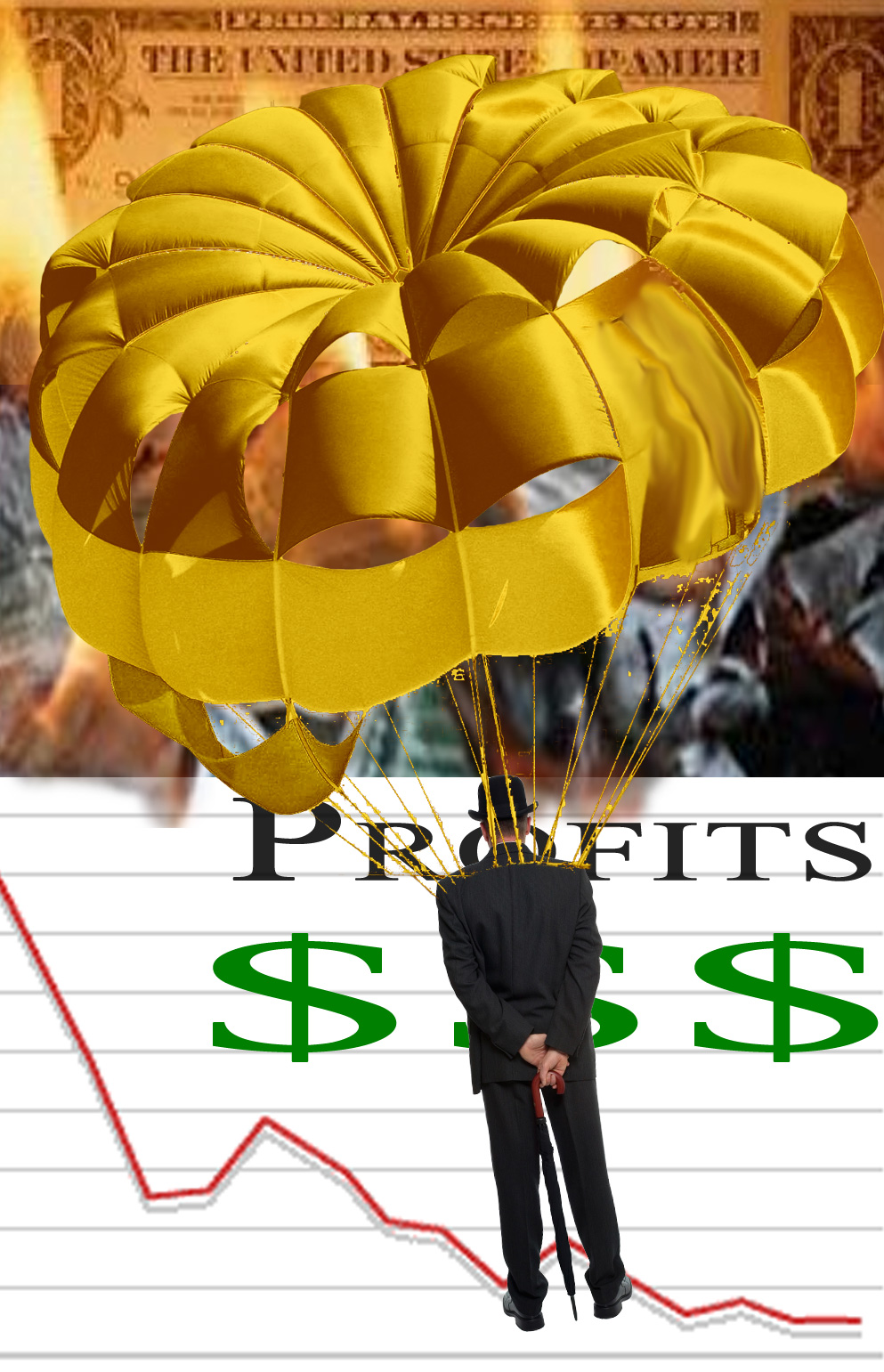
It sounds terrible, that executives get huge bonuses when a company goes under, but this clause actually saves many companies in the first place.
Why on earth do companies offer them, in the first place? Especially the ones that are already struggling…shouldn’t they refuse to offer a big severance package when they’re likely to go under, anyway?
Well, in fact, the struggling companies don’t want to offer those packages.
What happens is that the company does know it’s struggling, and so it is looking for the best CEO it can find, someone who can save it when its last managers obviously were just making things worse. But when they call the best guy available, they run into two problems:
- First, they can’t afford him, because they’re struggling. The money for his high salary could bankrupt them.
- Second, he doesn’t want to risk his reputation. If the company turns out to be too far gone, he will definitely get blamed, even if he did all that was possible.
Fortunately, they can solve both of these in one :
They can offer a lower salary now…what they and the executive agree they can afford, plus a huge severance package.
If the company is saved, then he’s earned it.
If the company goes under despite his great skill, then he gets compensated for his damaged reputation, and the pay cut he took during the time he worked there.
This means that a struggling company can hire a better executive, therefore increasing the company’s chances of surviving, if it offers a golden parachute.
So it’s actually better for the workers, shareholders, investors, and customers if a company does offer a golden parachute. Not just struggling companies, either…because it can always improve the executive a company can hire, therefore improving the company’s future.
Now there are other, obvious benefits to having golden parachutes.
Golden parachutes also help protect companies from hostile takeovers, because the executives of the taken-over company, inevitably all fired, will cost millions to the devouring company.
Really, any way you look at it, companies being able to offer golden parachutes is good for all involved. Including the regular employees.
Why Deflation is Bad…for You, Private Property, and Capitalism
Politicians and journalists are worried, right now, about a downward spiral of deflation, of the type that normally comes in an economic depression.
They are pointing to two signs we are having bad deflation…first, the falling price of commodities like oil, and the disappearance of money in this economic failure causing demand to plunge. One of those is actually good, the other is very bad.
When prices go down naturally, because of an increase in efficiency or improvement in technology, it is good for everyone.
For example:
- Improved efficiency makes the manufacture of computers cheaper, while more advanced computers make the old versions cost less.
- Food used to take up most of humanity’s effort, therefore most of a family’s cost of living, but has declined to third or fourth place as technology and efficiency allowed us to grow more with less.
The decline in oil prices, returning to only double their normal level, will cause a good kind of global price decline, because most prices are effected by the cost of the energy required to create and deliver products and services.
But, again, those specific cost reductions are not deflation.
What Are Real Deflation and Inflation?

When money deflates, people choose to just hold onto it, starving the marketplace and causing a spiral of ever more deflation
In real economic terms, inflation and deflation happen when the ratio of money to economic wealth changes. If the amount of money becomes greater, in comparison to the economy, then you get inflation. Because the most common result of this is for prices to increase, we confuse the terms and call general price increases “inflation”, but actually it’s the change in ratio that is inflation.
The eleven trillion-plus dollars of capital that have purportedly vanished in the past few months represent a huge decline in money supply, causing actual deflation. This failure was caused by the inability of central authority to manage money any better in the US than it could provide shoes and food in the Soviet Union.
Prices Can Increase Without Inflation, Too
Prices can actually increase for other reasons, and that’s not really inflation. For example, when oil increased 600% in price, it drove up the cost of production, without regard for the number of dollars in the economy. This general price increase was NOT inflation.
And when prices decrease for other reasons, it’s not deflation.
Inflation is Harmful
We all know that when the ratio of money to wealth increases, causing inflation, it is bad for the economy, and especially for the poor and middle classes. This is because it usually drives up prices, and the poorer you are, the more of your wealth and well-being is in cash.
Poorer people depend on cash they have in a bank, or other savings. They are paid by employers who give them only a set rate, plus raises for special reasons like increased skill.
Wealthier people tend to have more of their wealth in assets like, stocks and real estate, that will simply increase in price, sheltering them from some of the effect if inflation. They get cost of living increases in salary every year, on top of any other raises.
Deflation is Harmful, too
But the opposite kind of damage occurs if you have deflation, and is compounded by a new problem.
First, deflation artificially drives down prices. To a person with no real assets or investments, this sounds good, because “stuff costs less”.
But it comes at a horrible price.

Deflation punishes investments that can raise people from poverty, both personal investments, and business growth
For example, the decline in prices includes wages. Deflation is universal, with a shortage of money everywhere, so that your income will decline, along with the price you pay for things. What good is cheaper stuff, if you also have less money?
So people with fewer assets and no investments will more or less end up breaking even. But they still lose out in the end, because they become blocked from gaining assets, trapping them in relative poverty.
For example:
How Deflation Traps the Poor and Middle Class
Imagine you’re buying a house. Not on a sub-prime loan, but one where your income is perfectly fit for the home you’re getting.
It’s probably a thirty year loan. So you’re going to be stuck paying on the original price of your house, for thirty years, at the original size of house payment.
Now remember that your income (in dollars) is getting smaller every year. That’s deflation.
And the price of your house, too. Each year, its is worth fewer dollars, yet your original debt is the same. And so are your payments.
Within just a few years, you are making far less money, but are stuck with the same size house payment you always had.
While you still have to pay the same percentage of of your paycheck income for food, electricity, and so on, your house payment takes up a higher percentage of that money every year.
Soon, your income has shrunken to the point where you cannot make your house payment at all. Not even if you paid your whole check to the bank every week.
And worse, you can’t simply sell his house to get out of it. The price of your house has also declined every year. Selling it now that the payment is too high won’t even pay off your remaining house debt.
Of course people would quickly learn this, and that they simply cannot buy houses, unless they are so incredibly wealthy that they can save up enough to pay cash.
But even those wealthy people who can pay cash for a house now face the situation where buying a house is a horrible investment, because the house’s value will decline, in dollars.
It would actually be better to leave the money in a vault, and rent monthly, even for a billionaire, because the money’s value increases, while the house’s price declines. One thousand dollars will be worth more next year, if you simply stick it in your mattress, than one thousand dollars worth of house will be worth in that same year.
In fact, owning land becomes a losing proposition. With even the wealthy better-off renting, who’s going to actually be the landlord?
Deflation Attacks Economic Freedom
In fact, ALL property ownership becomes punished!
With deflation, anything you buy does not just depreciate with use and age, but declines in value every year with prices, compared to if you’d simply kept the money.
Today, you could buy that console game, or car, or collectible, and then sell it on eBay a few years from now and recoup part of the cost. But with deflation, the price you recoup is even farther from if you’d kept the cash in the first place.
Deflation Destroys Capitalism

Deflation punishes investment and property ownership, attacking capitalism at its roots
In fact (and this is where the entire economy implodes from deflation), simply holding on to your money is rewarded versus ANY investment, in a deflationary economy. If you put your money in a big ol’ vault, removing it from the economy entirely, it grows in value every year. But if, instead, you buy stocks, or invest in commodities, then your money is gone, replaced with an asset that becomes worth less every year, in dollar terms.
The growth of every business, in fact, would be undone by the rate of deflation. Now from the company’s standpoint, that is fine, because its expenses decline every year by the same amount.
But from an investor’s standpoint, a company growing at 2% per year during 3% deflation would mean you lose 1% over just stuffing your money in a safe. And yet you also risk, when investing money.
Why bother investing even in a company you think might grow at 5%, when you could have a 100% safe 3% investment in a vault under your mattress? So, really, the company facing deflation is NOT fine, because it discovers that it’s far harder to get investors. In fact, the entrepreneur who would have started that company is 3% punished each year for the effort, making him that much less likely to even bother.
With investors discouraged because of deflation, it becomes harder to create wealth. Capitalism, in fact, becomes almost impossible:
- An entrepreneur can’t get investors for his new project.
- There’s less reason to buy stocks, so companies can’t raise capital.
- You can’t get a loan to start a business, because your company’s income would decline every year, yet the loan payment would stay as large as ever.
With deflation, the very engines of capitalism all die out.
Speculation Defines Capitalism
It is the uncertain investment on the wild new idea that makes capitalism superior to central planning. Anyone can decide to invest in a “sure thing”: if that were good enough, socialism would work, because a government bureaucrat could declare money for the obvious solution. It’s diverse people choosing to risk money on many different wild ideas that lets the best solutions rise to the top.
But that very kind of capital investment, in a deflationary economy, is punished, because you get such a good deal by not investing in anything at all, but holding your money in a vault.
All of this, by the way, is aside from the additional destruction caused by the lack of downward price elasticity on many commodities and time-based investments. That’s much more arcane, but a key source of economic depression, that I’ll get into some other time.
For now, it’s enough to realize that prices being FORCED downward by deflation includes your pay, and the value of any investments you make, so that private property ownership, borrowing, and investing, in fact all capitalism, is crippled under deflation.
Not a Recession: A Depression
Why does this economic downturn seem different than previous ones in our lifetime? Why does it seem familiar to anyone who is familiar with the economic history of 19th and early 20th centuries?
Because, up to the mid 1940s, the US tended to face economic depressions. Since then, we had not had one…until now.
What we are suffering, today, is an economic depression.
Sure, it had been trendy, in the last decade or more, to say “we just stopped using the D word after the Great Depression”. But, once again, anyone who knows economic history realizes there’s more to it than that.
There is no official definition of an economic depression, other than the idea that they’re worse than recessions.
There isn’t really an official definition of an economic recession, either, although the pat answer is “two quarters of GPD shrinkage”. Real economists hate that definition, because it ignores more factors than it considers, to the point of being almost useless.
But we can simply examine what were called “depressions”, from 1800 through 1938, and compare them to the recessions between 1947 and 2007, and the differences are obvious.
Depressions, Described
Each depression / panic from 1819 through 1938 shared certain traits:
A shortage of money itself, leading to
- Usually at least 2 years, as many as 23 years
- Sudden runs on banks, causing bank failures
- Commodity price collapse, where something generic like cotton, steel, oil, or real estate plunged in value, causing a domino effect that devastated the economy
- A more general decline in prices across the economy
- A collapse in capital, for example stock market collapse, once that became an important factor
- A credit freeze, making loans and other forms of obtaining temporary money more difficult
- Massive business closings
- Astonishing amounts of job loss and unemployment
Now what about the subsequent “recessions”, from 1948 through 2003?
Recessions, Rescribed
Every one of them happened like this:
A dramatic raising of interest rates by the Federal Reserve, followed by
- Usually only a few months, rarely more than a year
- An increase in private interest rates
- An increase in unemployment
- Moderate to extreme price increases
- A plunge in the stock market and moderate tightening of capital
- Some amount of business failure
You can see examples of both recessions and depressions at the History of Economic Downturns.
What’s the Difference?
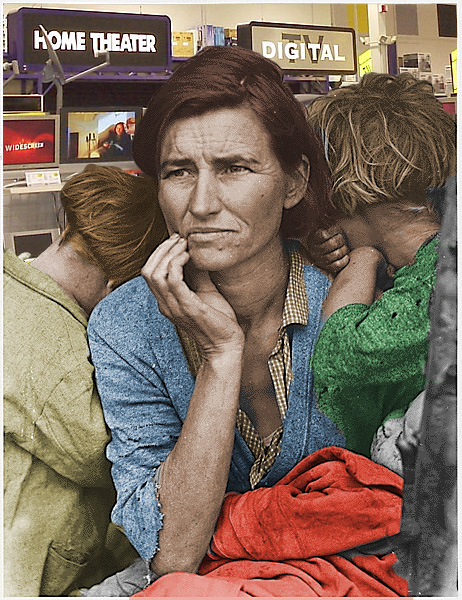
We face, as was normal during the days of the gold standard, massive bank runs, a credit freeze, price failures
Now the most obvious difference is timespan.
During the days of economic depressions, the downturns lasted much longer. Always years, sometimes decades. Economic recessions generally only last months, rarely more than a year…the longest recession has not lasted as long as the shortest depression.
The second is that the trigger is slightly different.
Depressions were caused by a direct shortage of currency (money) in the economy. This, in fact, led to the other obvious differences, like runs on banks, mostly caused by a shortage of money making people worry about bank stability.
Recessions, on the other hand, have been preceded, in every single case, by the Federal Reserve raising rates, trying to make it harder to get new money. That’s very similar, but it leaves the financial sector able to compensate, however painfully, so that bank runs and commodity price failures never become “necessary”.
And that’s probably the next most important difference:
During the depressions, bank runs were almost universal, commodity price collapse was normal, the loss of huge numbers of jobs and businesses was a constant.
In the era of recessions, none of those things occurred at all. Unemployment, though miserable, was generally only a few percentage points higher, and while some businesses failed, nothing like the tens of thousands of the depression days, even though the economy was smaller back then.
Now, which are we seeing today?
Are We Depressed?
- Runs on banks, and bank failures
- Real estate price collapse, along with some other commodities, including many metals like gold, copper, and nickel
- The massive price inflation expected to result from high energy prices failed to materialize, representing an inability of people to pay more, even though production cost had to rise
- A collapse in capital, for example stock market free-fall
- A failure in credit, making loans and other forms of obtaining temporary money more difficult
- Massive business closings
- A rising snowball of job loss and unemployment
Well, this does indeed sound almost exactly like a depression, not a recession.
And, in fact, it was preceded by a money shortage, just like other depressions. In our case, the shortage was caused by high oil prices, two wars, and hundreds of billions in new foreign “aid” shipping trillions of dollars overseas, much faster than the Federal Reserve was creating new money. This meant that, while the surplus of foreign-based dollars caused its value to plunge compared to foreign money, here in the US there was less money available than usual.
Without as much money, we could not maintain the prices of some commodities, we became distrusting of banks, credit became scarce…ultimately, a new economic depression was natural.
Why didn’t we have depressions from 1948 through 2007?
Up to the 1940s, the US had usually depended upon gold, and sometimes silver, to back its money. It claimed you could cash in a paper dollar, any time you wanted, for gold. This meant that money was, in a sense, just a glorified form of barter for a commodity.
In those days of a gold standard, if the economy grew faster than the supply of gold, this created a shortage of money, which could only grow as fast as people could dig up gold. When the economy grew faster, the relative shortage of money would eventually force banks to close, commodity prices to plunge, prices to decline, credit to freeze, and generally the economy to grind to a halt, to wait for gold to catch up.
That ended in 1946, when the US entered into the Breton Woods agreement. This was a sort of price fixing scheme, where instead of making a dollar equal to a certain amount of gold for exchange, each government just attempted to force the price of gold to remain a certain amount, compared to its money.
This happened to coincide, exactly, to the end of economic depressions. Without money being linked to the barter of a commodity that had its own separate value and supply, it did not end up in such short demand that the whole economy would fail. The recessions that did occur were from money shortages caused by the Federal Reserve, but these could be overcome, so banks never had runs, commodity prices never collapsed, et cetera.
This became even more true in the 1970s, when even the Breton Woods agreement was ended, and the price of gold became a legitimate free market price, not a fixed one.
Why are we having a depression, today?
As I noted earlier, this is the first time since the 1930s when there was a shortage of money so grave that we stopped trusting banks, could not pay for important commodities, and so on.
This is because we sent so much money overseas, out of our own reach.
The normal money we have sent abroad for decades, because we buy goods, was actually barely enough to keep up with foreign demand for dollars…but in 2001, that began to change:
The price of oil went through the roof. At its peak, we were paying 700% of oil’s natural price. This amounted to as much as one trillion dollars leaving the US to import oil, without getting anything in return (beyond what we normally got for 1/7th the amount).
Meanwhile, we engaged in two wars, that cost hundreds of billions of dollars, much of which went to foreign countries.
And, in order to support those wars, paid hundreds of billions in new “foreign aid”, money shipped abroad with no imported wealth to offset it, at all.
This left us without enough money to simply run our own economy.
The result? Bank closings, real estate and other price failures, massive unemployment, bankrupcies, business failures…
Another economic depression.
Trickle-Down Taxation

Item #2 of the Communist Manifesto: "A heavy progressive or graduated income tax". What isn't mentioned is that this was a way Marx could make the poor even poorer and weaker, not the rich. Marx gained power from the strife caused by poverty.
One of the best-sounding of the freebies that Obama is offering to hand out (if it’s not just another politician’s empty campaign promise) is exempting everyone who makes under $200K from the income tax. This one even tempts me. Lower taxes are good for the economy, for economic freedom, and of course for everyone who earns less than that amount of money.
But there’s a serious down-side to this. How do we fund all of the other freebies he is giving out, if we are going to cut government tax revenue with this one?
Of course the answer is simple: We are going to tax the people who make OVER $200K so much more that it makes up for the loss. Obama says it’s only fair, to “spread the wealth around”.
Now this may not be quite as bad as it sounds:
- First, people who make over $100K or so pay most of the taxes, already. Unfortunately, Bush’s tax cuts were not really all that “for the rich”, and “wealthy” people already pay almost all of the taxes. It was pointed out today that there are some companies, in fact, that are forced to pay more taxes per year, individually, than 66% of all families. It’s famous that the top two percent of earners pay something like 60% of the taxes.
- Second, tax cuts boost the economy, which increases tax revenue. Both Reagan and Kennedy both demonstrated this, cutting and simplifying taxes, and having tax revenue increase.
Unfortunately, those two things aren’t enough. The billions paid by people who earn less than $200K still adds up…and tax cuts don’t all work equally well.
For example, tax cuts that favor one group over another help the economy less, while ones that spread the burden evenly help everyone more. In fact, simply spreading the burden evenly, with NO tax cut, would boost the economy more than cutting taxes for some people, while raising it for others.
Especially when the taxes (as they already, are, and will now be more) are designed to punish hard work, success, and contribution to society.
Just as a slight increase in interest rates, so small it certainly doesn’t change any one person’s mind, has a large nation-wide impact on how much people borrow, so a tax that increases as you earn more money has a nation-wide impact on how much people earn, depressing income growth.
But there’s something involved, that’s more important than ALL of that:
WHEN Barak Obama raises taxes on people who earn more money, the wealthy will not pay a penny of it.
You will.
The counterpart to trickle-down economics (which points out that wealthy people who earn more money spend and invest more, allowing all of society to become more wealthy) is…
Trickle Down Taxes
When you raise taxes on the rich, they ALWAYS respond to defend their wealth. The more money and power they have, the better they can do this. They can give themselves raises, pay accountants to shelter their income, or otherwise make up for the new tax.
But where do they get the new money, to pay themselves enough to make up for the taxes?
From you.
Wealthy people and companies can, for example, raise prices to pay themselves enough extra to make up for the taxes. Guess who pays the higher prices.
They can also cut jobs or pay among their employees, in order to make enough to pay themselves more. Guess who the employees are.
Along with those two tools of passing along higher taxes, the rich and powerful can cut quality of products, again to save for themselves. Ice cream that was once two quarts is now 1.5 quarts, and the same price. Check Edy’s and Breyer’s, next time you’re shopping. Guess who ends up paying for all the reduced-quality/quantity food. Not the rich guys…the can afford to pay a premium for consistent quality.
Ultimately, ALL costs the government imposes on the wealthy, they pass down to you.
Oh, but the tax trickling isn’t done, yet.
If They Lose, You Lose More
Let’s say you, somehow, manage to force the wealthy and powerful to pay for their own taxes.
You are now shutting thousands of people out of jobs, and, causing more hunger and poverty.
Why?
Because the wealthy don’t put their money in giant Scrooge McDuck vaults, to play in while they cackle wickedly. Instead, they either spend or invest it. Spending it creates jobs directly. If they buy a car, someone built it, someone shipped it, someone sold it, people repair it, people clean it…maybe someone even drives it as their job. The less money ANYONE spends, the less work there is. But, let’s face is, the wealthy have more money, per person, than other people, and therefore supply more jobs with money.
Poor people have to mow their own lawns (if they have them). Middle class people may be able to pay someone to mow their lawn for them. A few dozen families might, between them, manage to keep one lawncare guy employed. But one wealthy dude may employ a half dozen lawn guys, all by himself.
Take away his money, and the rich guy may have to lay off his lawn people…perhaps one hundred times the job impact of a middle class person having to stop hiring a lawn guy.
But most of a wealthy guy’s money is not spent, so it doesn’t make jobs.
Well, not directly.
Investment Creates Jobs
The “capital” in capitalism is investment.
Rich people and companies are the reason most new jobs ever get created at all, because it requires investment to build the factory, or store, or restaurant, whatever it is. Even when poorer people start their own successful business out of pocket (something pretty rare, because of government regulation and taxes), they only create large numbers of jobs as they become successful and rich.
One of the many reasons the economy is so weak, now, is because investment is so rare, thanks to punishment of investment through taxes, regulation, deflation, and the preference for stagnating money shelters like bonds and treasury notes, over the stocks to which government has proven to be so hostile.
If we are to get back on the road to economic growth, we must first get on the road to economic freedom for all, including the wealthy, who just happen to pass on ALL effects we try to have on them, good or bad.
Why Oil and Gas Prices Are Falling
We all know that high gas/energy prices, driven by high oil prices, are a large part of what has crippled the US economy.
But what has caused that?
Oil prices are not set by oil companies, but by futures and commodities speculators, who bid on the oil at auctions. The companies have no more control over the price than someone selling with a regular auction on EBay.
The speculators decide what they are willing to pay, based on what they believe the future of oil to be.
How Prices Rose
In 1999, the monopolistic oil cartel OPEC started cutting production, specifically to help themselves and their allies get rich by driving up the price of oil. Speculators, naturally, started bidding more for oil, expecting there to be a shortage. It went from well under $20 per barrel to over $30.
Then George W Bush got elected.
People assumed, because wealthy oil barons in Texas and Saudi Arabia were largely responsible for financing him, that plentiful oil was in their future. This ignored history, of course, because plentiful oil is cheap, and cheap oil is bad for oil barons. The more expensive oil is, the better. It would have made more sense to expect Bush to do things that would drive up the price of oil.
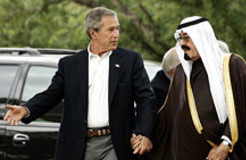
Bush holds hands with a member of the Saudi tyranny, top state sponsor of terrorism, and leader of the push to keep oil prices high
But they assumed it’d be plentiful, so they bid lower on it, and the price fell. It got almost back down to its natural, under-$20 price range.
But that was bad for Bush’s financiers.
In fact, there was a lot of loud public worry, among oil barons, about how the price of oil was returning to normal.
Then came September 11th, 2001.
Afghanistan
After 9-11, there were many ways America could go.
The way Bush chose to lead, was to first attack Afghanistan. He said this was because they were harboring bin Laden. He promised, though, that he was going to exhaust all diplomatic means, and only attack them as a last resort.
But before he attacked, the government of Afghanistan, a long-time US ally whom Bush had just recently sent, openly and on record, a great deal of grant money for their help, offered to turn over bin Laden for war crimes trial.
Bush ignored the offer, refusing even to discuss it with them. When they offered a second time, the US attacked the very next day.
Speculators saw this as a very bad sign for oil, because Afghanistan was closely aligned with many oil-producing countries, and they bid more for it, driving the price into the high $20 range, fifty percent higher than its natural price.
Iraq
Then Bush began threatening to attack Iraq. Now Afghanistan had at least some association with Al Qaeda…but Iraq, of course, was ruled by Al Qaeda’s #2 enemy after the US: Saddam Hussein.
Oil speculators found this pretty scary, and confusing. The price of oil rose to close to $40, more than twice its natural range.
Gradually, it declined, on the promise of cheap oil from Iraq, even though every government projection of conquering Iraq anticipated years of quagmire and turmoil, jeopardizing oil supplies for a long time to come. This is why his father had not done it.
(more after this K-rad graphic)
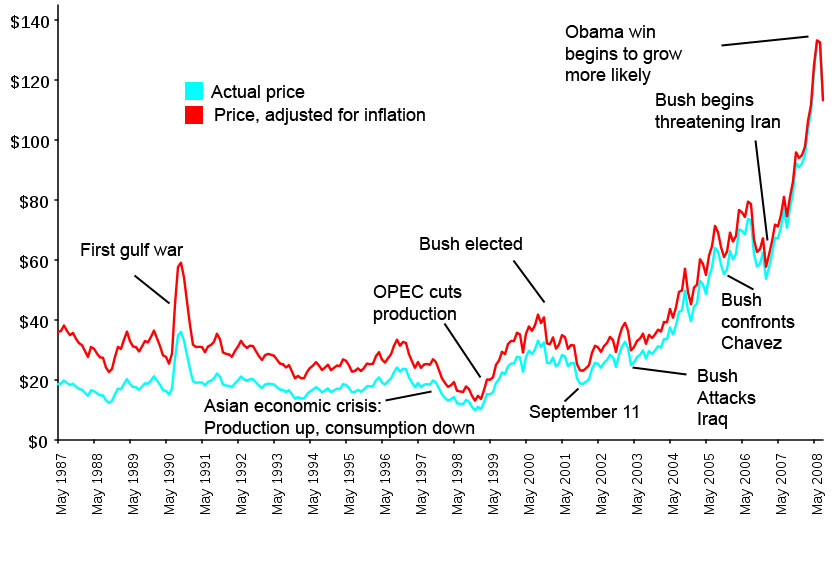
Oil Prices, Real and Adjusted, from 1990 to mid 2008
Sure enough, as time war on, the war got worse, and the speculators responded by bidding ever-higher for oil.
General Belligerence
What’s more, whenever the price was finally stabilizing a bit, the Bush administration would do something else that threatened the oil supply, like picking fights with Hugo Chavez, or threatening to attack Iran. Each time, investors were frightened, and the oil price climbed.
Eventually, this kind of belligerent foreign policy pattern pushed it up to $140 per barrel, over 700% above its natural price of just a few years earlier.
Sane Foreign Policy?
Then, in early 2008, it began to grow increasingly likely that Barak Obama would be the Democratic nominee. Unlike Hillary, he had always opposed this kind of foreign policy. Speculators began to weigh the possibility of a different foreign policy into their price bids.

As Obama's election grew more likely, oil buyers became reassured that oil supplies might be secure, and bid less, driving down prices.
As he clinched the nomination, and then began to dominate the polls versus McCain, the amount speculators were willing to pay steadily declined.
By the time he was elected, which had been seen as a probable for some time, they had built a peaceful foreign policy into the price, so that it was half its peak.
The day after he was elected, the price fell dramatically.
Now it remains in a holding pattern, a fraction of its peak just a year ago…waiting to see if Barak Obama is going to keep his promise of sane foreign policy. If he does, we could see oil falling down to its natural price, which by now is probably little more than $30 a barrel.
Ironically, sane foreign policy has an even greater impact on what the investors in oil are willing to pay, than Obama’s own position as a Liberal enemy of the energy needs of Americans.
Why Nobody Wants to Bail Out Automakers (except bureaucrats)
One thing you’ll notice about the debate over bailing out the automakers is that, even more than in general, everyone’s against it except corrupt politicians, panhandling automakers, and monopolistic union officials.
That’s because it’s a lose/lose situation if we do, but things might actually get better if we don’t.
First, let’s consider the big, fat lie that three million people would be put out of work.
We’ll ignore (for a moment) that bankrupcy will actually keep them in business and let them become more efficient.
Let’s pretend, instead that the automakers would actually [poof] ceased to exist. Only a couple hundred thousand workers, not three million, actually are employed by those car companies.
If the companies vanished, then all other 2,800,000 workers would not only continue to have jobs…
(continued after the spiffy pic)
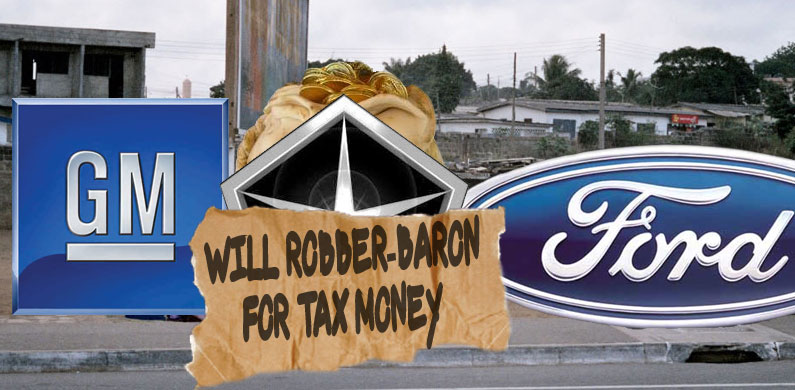
They claim three million jobs are at stake, but the bailout would actually cost jobs, and make a few union management types rich
…but probably end up with better versions of their jobs. Why? Because people wouldn’t stop buying cars, they just would be buying DIFFERENT cars. Cars that need dealers, mechanics, parts sellers, and all the other jobs that the car companies are dishonestly counting as “three million jobs”. If you don’t buy a car from the Big Three oligopoly of panhandlers, you’ll buy one from someone else, instead.
Of course foreign cars often don’t need repairs and parts as often as American cars, but THAT would represent a savings for americans in general, that would create more jobs.
But, of course, the Big Three are in ZERO danger of magically vanishing.
Instead, they’d have to file for bankrupcy “restructuring”, which would be a way to allow them to fix a lot of the stupid inefficiency that laws and bureaucracy have trapped them with, WITHOUT them having to steal twenty five billion dollars (a number that will grow) from you and me, and then have Big Brother socialize them with mandatory “changes” that don’t represent what we consumers want, anyway.
And…well, really, that’s it. There are no other excuses for squandering $500 from the pocket of every middle-class family on yet another socialist bailout. Just “three million jobs” that is really only a couple hundred thousand jobs that would not go away, anyhow.
Sure, I could point out how restructuring, instead of a bailout, would break the back of the UAW monopoly, which forces American car companies to pay nine times as much for labor as foreign car companies. And how the UAW is therefore bribing the Democrats the way the Big Three automakers are bribing the fake-Republican neocons…which might just happen to be why they are all for the bailout, when everyone else is against it.
But, really, it boils down to “three million jobs is a lie”.
In fact, it boils down to the fact that americans would probably GAIN jobs from letting GM file for restructuring, while we will LOSE jobs by squandering more money on the bailout, which will ultimately come out of YOUR pocket, and mine. When the government wastes money, we lose the opportunity to spend the money on actual, productive things that employ people.
We need more economic freedom, to regain true American prosperity, not more handouts lifted from our own pockets.
Examining Barak Obama’s Economic Agenda
The Federal government has actually set up a website for “The President Elect”, at http://www.change.gov/ It contains an “Economic Agenda”, that is very specific and detailed. Below is a cursory analysis of parts of that document. http://www.change.gov/agenda/economy_agenda/
Barack Obama and Joe Biden’s Plan
Jumpstart the Economy
- Enact a Windfall Profits Tax to Provide a $1,000 Emergency Energy Rebate to American Families:Barack Obama and Joe Biden will enact a windfall profits tax on excessive oil company profits to give American families an immediate $1,000 emergency energy rebate to help families pay rising bills. This relief would be a down payment on the Obama-Biden long-term plan to provide middle-class families with at least $1,000 per year in permanent tax relief.
- Provide $50 billion to Jumpstart the Economy and Prevent 1 Million Americans from Losing Their Jobs: This relief would include a $25 billion State Growth Fund to prevent state and local cuts in health, education, housing, and heating assistance or counterproductive increases in property taxes, tolls or fees. The Obama-Biden relief plan will also include $25 billion in a Jobs and Growth Fund to prevent cutbacks in road and bridge maintenance and fund school re pair – all to save more than 1 million jobs in danger of being cut.
- Eliminate Income Taxes for Seniors Making Less than $50,000: Barack Obama will eliminate all income taxation of seniors making less than $50,000 per year. This proposal will eliminate income taxes for 7 million seniors and provide these seniors with an average savings of $1,400 each year. Under the Obama-Biden plan, 27 million American seniors will also not need to file an income tax return.
- Improve Transition Assistance: To help all workers adapt to a rapidly changing economy, Obama and Biden will update the existing system of Trade Adjustment Assistance by extending it to service industries, creating flexible education accounts to help workers retrain, and providing retraining assistance for workers in sectors of the economy vulnerable to dislocation before they lose their jobs.
- Reward Companies that Support American Workers: Barack Obama introduced the Patriot Employer Act of 2007 with Senators Richard Durbin (D-IL) and Sherrod Brown (D-OH) to reward companies that create good jobs with good benefits for American workers. The legislation would provide a tax credit to companies that maintain or increase the number of full-time workers in America relative to those outside the US; maintain their corporate headquarters in America if it has ever been in America; pay decent wages; prepare workers for retirement; provide health insurance; and support employees who serve in the military.
Invest in the Manufacturing Sector and Create 5 Million New Green Jobs
- Invest in our Next Generation Innovators and Job Creators: Obama and Biden will create an Advanced Manufacturing Fund to identify and invest in the most compelling advanced manufacturing strategies. The Fund will have a peer-review selection and award process based on the Michigan 21st Century Jobs Fund, a state-level initiative that has awarded over $125 million to Michigan businesses with the most innovative proposals to create new products and new jobs in the state.
- Invest In A Clean Energy Economy And Create 5 Million New Green Jobs: Obama and Biden will invest $150 billion over 10 years to advance the next generation of biofuels and fuel infrastructure, accelerate the commercialization of plug-in hybrids, promote development of commercial scale renewable energy, invest in low emissions coal plants, and begin transition to a new digital electricity grid. The plan will also invest in America’s highly-skilled manufacturing workforce and manufacturing centers to ensure that American workers have the skills and tools they need to pioneer the first wave of green technologies that will be in high demand throughout the world.
Support Small Business
- Provide Tax Relief for Small Businesses and Start Up Companies: Barack Obama and Joe Biden will eliminate all capital gains taxes on start-up and small businesses to encourage innovation and job creation. Obama and Biden will also support small business owners by providing a $500 “Making Work Pay” tax credit to almost every worker in America. Self-employed small business owners pay both the employee and the employer side of the payroll tax, and this measure will reduce the burdens of this double taxation.
- Protect Striking Workers: Obama and Biden support the right of workers to bargain collectively and strike if necessary. They will work to ban the permanent replacement of striking workers, so workers can stand up for themselves without worrying about losing their livelihoods.
- Raise the Minimum Wage: Barack Obama and Joe Biden will raise the minimum wage, index it to inflation and increase the Earned Income Tax Credit to make sure that full-time workers earn a living wage that allows them to raise their families and pay for basic needs.
Establish a Credit Card Bill of Rights to Protect Consumers: Obama and Biden will create a Credit Card Bill of Rights to protect consumers. The Obama-Biden plan will:
- Ban Unilateral Changes
- Apply Interest Rate Increases Only to Future Debt
- Prohibit Interest on Fees
- Prohibit “Universal Defaults”
- Require Prompt and Fair Crediting of Cardholder Payments
Obama and Biden will reform our bankruptcy laws to protect working people, ban executive bonuses for bankrupt companies, and require disclosure of all pension investments.
[Bonuses for CEOs of bankrupt companies SAVE companies from bankrupcy. The best CEOs will refuse to work for a struggling company…the kind of company that needs them most…unless there is some guarantee that, if it fails anyway, the damage to their reputation is paid for. The best executives will cease to be willing to rescue struggling companies, resulting in MORE failures, and more job loss.]
About
 This site has its origins before the word “Blog” existed. Back then its owner, Kaz, was simply thought of as having a website that published socio-political articles with regularity…But the only real difference was that the RSS/XML protocals were not yet used this way.
The website was known as Site of the Sentient, a reference to the famous Words of the Sentient, that Kaz had been editing for years previously.
When some random portal site hijacked the domain siteofthesentient.com, it was a dark time for the human knowledge quest. Fortunately, But Now You Know is striving to take up the slack, and even has some revamped versions of the original articles, for example Conscription, is it Slavery, and How to Get Out of Jury Duty, and be a hero instead of a bad citizen.
Kaz is a writer, graphic artist, and supplements his income by being a hardcore senior web developer.
Along with this blog, you can track his efforts with the dedicated facebook page here.
Speaking of tracking:

You can follow But Now You Know here, on Twitter

And you can follow But Now You Know, via our Facebook Page, here.
Share This Article

 Words of the Sentient
- Tolkien, on Government
- Criminals Are Never Disarmed — Robert Heinlein
- Power Attracts the Corrupt — Frank Herbert
- Under Democracy — H.L. Mencken
- Guard Your Enemies from Oppression —> Thomas Paine
- Your Right to Not Support Evil
- Global Warming Shamanism
- The Squeaky Wheel…May Be Foolish
- Disarming the Victims
- The Inconvenience of Too Much Liberty
Recent Comments
- Pithy Pontifications
- An error has occurred; the feed is probably down. Try again later.


 But Now You Know