Why Workers Dislike Unions
We’re told by teachers, politicians, and the media that unions are the best thing ever to happen to people who work. Without them, we’d all be working 80 hour weeks, for pennies per hour, and dying by 30 from how dangerous the conditions are.
And yet, for some reason, most people not only don’t belong to unions, are not even thinking about forming unions, but wouldn’t even want their industry unionized, if they had the chance. In fact, unions are dying out. The odds are that if you don’t more or less inherit a union career because you’re locked into a Company Town situation, you will never join one.

As Americans have gained more freedom to leave unions, they have mostly chosen independence
In the 1940s, 35% of American workers belonged to trade unions. Today in the private sector, membership is less than 7%. It is even lower in states that protect your right to have a specific job without joining a union.
Why?
Because, in reality, a union takes more freedom away from a worker, than from anyone else.
Pay is Important
It’s not fun, negotiating with an employer for your compensation. Well, not unless you’re really in demand. Then it can be joyful agony, trying to decide which offer is best, and what to require you be paid…but, the rest of the time, it’s unpleasant.
But the joy and pain are both because of how completely important your pay for your work really is. Your entire lifestyle depends on that set of decisions.
Not just how much you’ll be paid, but in what form. Do you want more cash, or would you prefer more days off? Are you better off putting up with a company insurance plan, that is cheaper but less responsive and lacking in choices, or more money and save up for your own checkups? Do you want paid lunch and breaks, or more money and come home sooner?
The problem with a union is that it strips away any control you have over that life-changing question.
You don’t even get to choose when, or how, to negotiate. Union management takes all power away from you, and you have to cross your fingers, praying whatever they think is best happens to be something you can tolerate.
Even under the best circumstances, they’ll be negotiating for the lowest common denominator. What the average worker is worth, and the union will gain from getting. The problem is that in the real world, almost nobody’s average. A good compromise, famously, is one where everyone goes away equally unhappy. With a union, you don’t just have to compromise with an employer, but also with all of the other workers.
You Become a Cog
With a union, you must settle for:
What the average worker is worth…
Diluted by what benefits the union management and corporate management negotiate.
You also lose the power to be paid for your effort, quality, ideas, and unique traits.
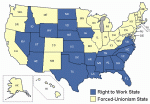
Right to work states protect your choice to not join a union, even if there is one at the company where you work
For example, you may be willing to work extra-hard to make more money, or have more job security. You may not even need to work hard; there may be some special part of your occupation you’re particularly good at.
But most unions avoid the idea of being paid for how well you do the job, replacing it with being paid for how many years you’ve worked. What could be a worse system of payment than this?
Of course it’s bad for the customers, because quality falls by the way-side…and therefore is bad for the company, as its profit depends on that quality. But it’s also bad for you, the worker, whose efforts become meaningless…just hang on to the job for as long as you can, that’s the only way you can make more money.
Likewise, no amount of effort can protect you from being laid off during the slow or hard times, with a typical union contract. You could be the very best at your job, but if you’ve only been there a few years, you’re out the door.
The Worst Kind of Middleman
It’s bad enough that unions harm companies, consumers, and society by causing unemployment, playing insider favoritism, price increases, inefficiency, low quality, reducing non-union worker pay, and other means, plus all the above disadvantages to union members, but what do you gain, in return for this?
- The right to be forced to pay union dues, whether you find them worthwhile or not.
- The privilege to have part of that hefty fee spent to bribe government officials with policies you probably don’t actually like, and be punished if you object.
- The fortune of having some of the rest divvied up among the secretive, corrupt union management and their cronies and masters, for no apparent reason whatsoever.
- Oh, and the joy of having yet another Tyranny of the Majority government ruling over you, in the form of that union’s quasi-elected crony management.

You have a right to set your own standards, not depend on a bullying middleman
It’s no surprise that unions actually reduce real household income.
Not a Number, but a Free Man
The reason most of us eschew labor unions like they’re a porcupine who recently attacked a skunk’s posterior, is that we really are better off as free people, than as vassals of a collective, whose real function seems to be the profit of its “leaders”.
In other words, I’d rather protect my right to earn pay based on what I’m worth, not my seniority, and not be given useless token “compensation” that sucks part of it away, like hourly coffee breaks and a dubious promise of unreasonably high, distant retirement pay, I probably won’t see, once the union bankrupts my employer.
Wouldn’t you?
Words of the Sentient:
Unionism seldom, if ever, uses such power as it has to insure better work; almost always it devotes a large part of that power to safeguarding bad work.
– H. L. Mencken
– Henry George
The Tyranny of the Majority, vs the Unanimity of Liberty
T
he Founding Fathers despised democracy. They called the idea of 51% voting to impose its will the “violence of majority faction“. Poor Thomas Jefferson spent a great deal of effort and political capital proving he wasn’t a closet democrat. When writing Democracy in America, French philosopher Alexis DeToqueville coined the phrase Tyranny of the Majority referring to an idea from Plato’s Republic.
Majority rule imposes the will of a mere half of the population, plus one vote, upon minorities in each issue.
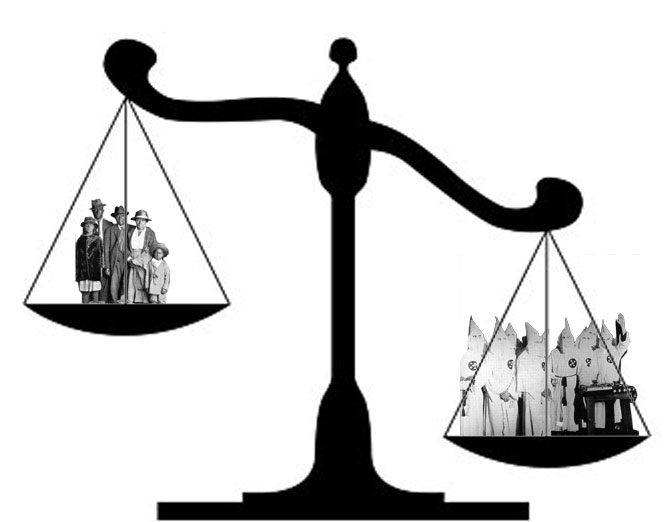
It is just as wrong to violate someone else's rights, even if you outnumber them and have a vote
You need only to look at how this impacted blacks in the US to understand how evil majority rule over the minority is.
The Founders sought to solve this problem, by banning democracy in America, setting up a Republic where the majority could never legally vote to violate the natural rights of the minority. The only powers allowed to the Federal government were those listed in the Constitution, with the 9th and 10th articles of the Bill of Rights banning it from doing anything else, even if the majority voted for it.
Majority as Consensus
Of course the Federal government has been corrupted enough to overstep its legitimate authority, but that’s another article.
The modern apologists for majority rule, who unfortunately have managed to get the word “democracy” spun into a positive thing in public schools, defend their tyranny over minorities by saying “hey, at least we can be sure that there isn’t a larger group who opposes a vote, than the group who supports it”.
Advocates of liberty, though, object that you still should not violate the will of ANY people, in a free society. They say that you have no more authority to violate the rights of another because you are a large group, than if you are one man trying to impose your will on your neighbor. At least not legitimately.
Of course, the obvious retort is “hey, the only way to solve the problem of having minorities on issues is to have a unanimous vote…and that’s impossible! If we depended on unanimity, then nothing would ever get accomplished at all!”
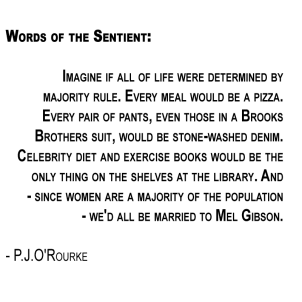 But this isn’t true:
Unanimous Self-Government
A free market is based, purely, on unanimity.
This is because the fundamental principle of liberty is private property:
Each person is a government of one, over his rightful possessions, starting with his own body.
But if someone wanted a vote on what everyone in the country is going to have for supper tonight, the odds are that he would not be able to get everyone to agree on the same thing. So if this were a power of the government, up to half of the population, minus one vote, would have their right to choose what to eat violated.
Of course that’s if there are only two options…which is a sort of farce of an election in the first place. With a real selection of all things people might reasonably desire for supper, probably more than 99% of people will be forced to eat something they would not have chosen.
And, let’s face it, with how goofy people are, you’re almost always going to end up being forced to eat something you don’t even like, much less want for tonight.

Eccentric sitcom character Mrs. Slocombe used to emphasize a decision by saying "and I am unanimous in that!"
On the other hand, if each man governs his own life, as in a free market, then you may choose not only exactly what to eat, but even when to eat it.
Every time you are hungry, there is a vote, and you are unanimous. Sure, it’s limited to what you can afford, but what better way to determine what a meal is worth than that? Imagine if the majority were always voting themselves caviar and steak, bankrupting society.
With majority rule, you only get rare input at all, and only one option is selected, with most people being losers in the process.
But with the free market, you vote every instant, of every day, and are able to reverse yourself at will.
Of course, this also applies to groups, not just individuals, because their membership is purely voluntary, unlike an authoritarian government:
Sure, your chess club or paintball team may have majority votes, but your participation in them is purely consensual. Each moment of your life, you are free to leave, and if you stay you are voting unanimously for your own membership.
If you leave an organization in a free society, they are not going to blockade your house until you’re forced to fire on them, and then claim you started a hostilities, invade, and conquer you.
 If the majority of your local town council votes to condemn your perfectly sound family home, just to put up a strip mall that will bring them more tax money and campaign contributions, it does this in violation of the unanimity of private property rights, and you can’t simply withdraw your membership.
Don’t worry; in two years you’ll be allowed to cast a single vote against at least one of those politicians who stole your home…if you still live in town, and at a legal residence, not in a cardboard box.
You might even try to get 51% of all voters in your city to set aside all other issues and vote for the single challenger to each of those bad politicians.
Of course, if your private property rights were protected as they should be, you wouldn’t be in this predicament. Maybe you should just push for laws protecting those rights in general, so such things couldn’t happen in the first place.
While majority rule imposes tyranny over minorities, capitalism, through private property rights, protects even the smallest minority, that of the individual, with unanimity.
Words of the Sentient:
The political principle that underlies the market mechanism is unanimity. In an ideal free market resting on private property, no individual can coerce any other, all cooperation is voluntary, all parties to such cooperation benefit or they need not participate.
— Milton Friedman, The Social Responsibility of Business is to Increase its Profits, The New York Times Magazine
Measures are too often decided, not according to the rules of justice and the rights of the minor party, but by the superior force of an interested and overbearing majority
— James Madison, Federalist Papers #10
Remember, democracy never lasts long. It soon wastes, exhausts, and murders itself. There was never a democracy yet that did not commit suicide.
How, Exactly, Are They Defending Our Freedom?
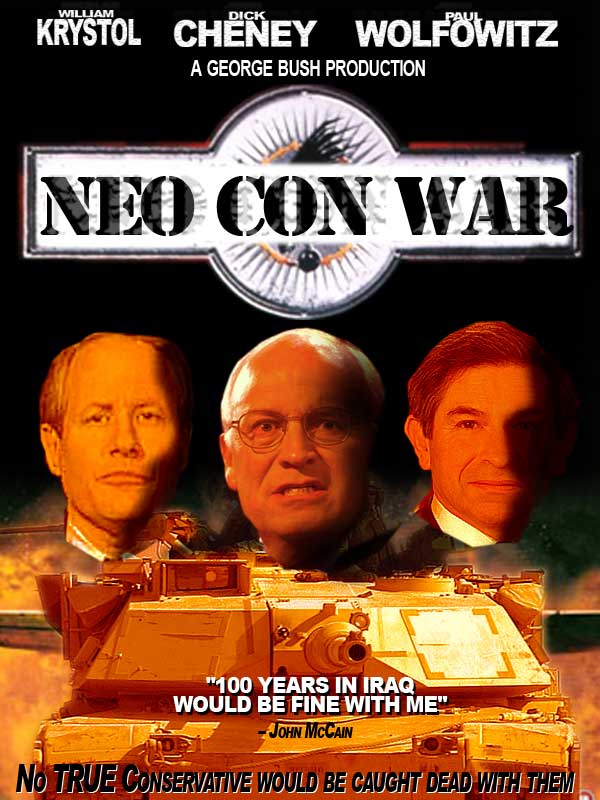 When people object anything relating to the wars in Iraq and Afghanistan, neocons claim that they should be quiet and comply, because the criticism hurts the feelings of “the troops”, who are busy “defending our freedom” over there.
I do appreciate that the soldiers feel like they’re serving America…but defending our…freedom?
Our freedom? We Americans, here in the United States?
When I’m faced with this argument, it is hard to give a clear, coherent response for or against, because the claim makes no sense to me, whatsoever.
This is an honest question, not sarcasm:
What, exactly, does the conquest of Iraq have to do with American freedom?
Did we conquer Iraq for American freedom?
- First, we built up momentum to attack because Hussein was supposedly involved in 9-11.
But then it became more widely understood that Hussein was one of Al Qaeda’s mortal enemies. In fact, one of the things bin Laden demanded was that Hussein, whom he referred to as a socialist infidel, be removed from power. So…
- Second, when we actually attacked, it was supposedly because of Weapons of Mass Destruction. We knew Iraq once had WMD, because we openly sold Hussein the technology for them, in the 1980s, and claimed we thought they still had somehow kept some, despite the years of inspections.
But it turned out, after we got there, that we had known he didn’t have the WMD any more at all, so…
- Third, we retroactively decided we were there to remove Saddam Hussein from power. He is a dictator, killed hundreds of thousands of people, imposed tyrannical laws, et cetera.

Donald Rumsfeld shaking hands with close American ally Saddam Hussein, in the 1980s, shortly after the US acknowledged Hussein had been using WMD against civilians.
Of course we supported him doing ALL of those things, including the mass murder, for decades, we even sold him WMD tech months after acknowledging that he was slaughtering innocents with it, but let’s just pretend that’s why we invaded, anyway. It sounds good.
The problem is that NONE of those things have anything to do with American freedom.
The Warfare Facts
- First, 9-11 wasn’t an assault on American freedom. Al Qaeda was attacking in order to change our foreign policy (giving money to Islamic tyrants, occupying Saudi Arabia, killing a million people in Iraq with economic sanctions, backing Israeli war crimes).
…in fact, the only 9-11 related assault on freedom was domestic, like the PATRIOT Act.
- Second, American freedom wasn’t going to be threatened by Hussein having mustard gas, or anthrax, or even nuclear bombs. Nobody ever seriously suggested he could conquer the US with his mighty navy of 16 wooden patrol boats and his deadly force of a few dozen short-range SCUD missiles, no matter how many WMD he loaded on them.
Liberty depends on economic freedom…whomever controls your life needs, controls you. This war has crippled the US economically, which had turned into an assault on our freedom of choice. By the way, why exactly did we sell him WMD technology in the first place?
- Third, that’s barely even a fight for Iraqi freedom, since they’re voting as much against freedom now as anyone who knew about the region would have expected. The laws passed are on their way to becoming more repressive than under Hussein’s secular government. These include a move to make burqas mandatory, and growing bans on freedom of expression. Certainly overthrowing Hussein has nothing to do with freedom here in America.
Actual Assault on American Freedom
Because we’ve been “on war footing” for six years, BOTH parties have used the “don’t criticize the government during a war” argument, dramatically attacking American freedom of expression. We have had “free speech zones“, warrantless wire tapping, demands that we not criticize foreign policy lest the troops feel bad, secrecy regarding torture and other violations of American principles, et cetera.
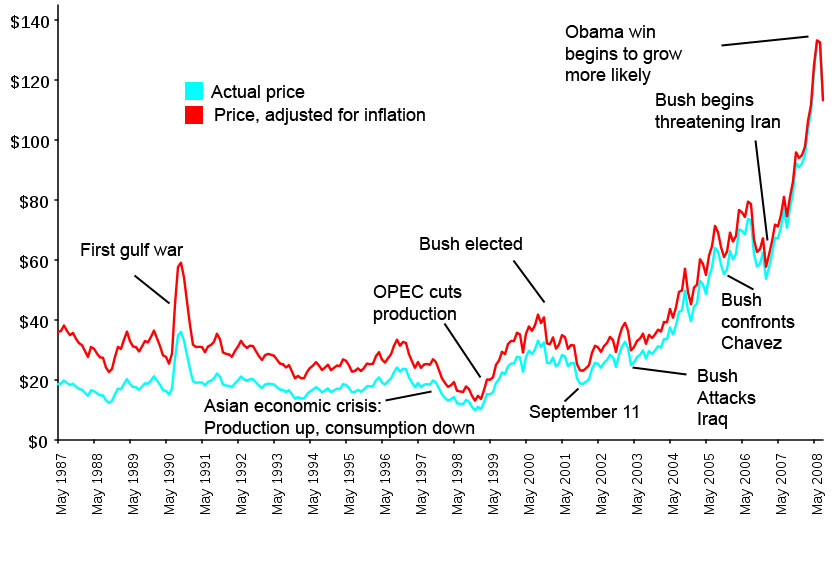
Oil Prices, Real and Adjusted, from 1990 to mid 2008
We have had economic malaise caused by both the huge deficits and diversion of wealth-production the war produced, and the 700% increase in the price of oil that attacking or threatening four different oil-producing nations caused. And this resulted in a depression that Bush and Obama have used to expand government massively into our personal lives, and to loot our future to pay off failing multinational corporations, perhaps the most vicious of the attacks on our freedom.
You know, there may be a country closer to home than Iraq, where our troops should be fighting a government that is attacking American freedom…
Anyway, I definitely need someone to explain what is the “defending AMERICAN freedom” part of invading, conquering, and occupying Iraq.
Words of the Sentient:
A thing is not necessarily true because a man dies for it.
— Oscar Wilde, A Portrait of Mr. W.H.
Cash for Clunkers Causes Pollution and Poverty
This was going to be an article about how the Obama administration’s “Cash for Clunkers” campaign is an assault on the poor — which it is, because it breaks the flow of newer used cars to poorer people — but, in gathering facts for it, I came to realize that another of the unintended consequences of this self-destructive law is that it, literally, will increase pollution.
Why?
Ultimately, both of these side-effects are caused by the bizarre, authority-obsessed requirement that the cars traded in be destroyed, not sold to owners of even older cars.
Cash for Clunkers Pollutes
This is because the older a car, the worse its gas mileage. Not only in general, but also because cars tend to perform worse as they age.

But Now You Know is getting GREAT mileage out of this picture of the wind-powered Aerius, that charges its own hybrid battery while driving, in defiance of the laws of thermodynamics
Cash for Clunkers only rewards people for buying new cars, not for simply buying any car that got better gas mileage, regardless of its age. And it destroys the cars traded in, regardless of their own gas mileage.
This means that only more-prosperous people, who can afford new cars, are able to use the C4C program. They are, therefore, often trading in relatively nice, fuel-efficient cars. Often, they are even buying cars only a couple of miles per gallon more efficient.
Meanwhile, what about the people with older cars, which are much less fuel efficient?
Simple: They are having the nicer, more efficient used cars they WOULD have bought destroyed. Leaving them in a pollutive car longer than if the C4C never happened in the first place.
Since the older the car, the more pollutive, this has the net effect of WORSE pollution, not better.
Someone buys a new car that gets two miles per gallon better. His used car is destroyed, instead of going to someone who owns an older car that gets TEN miles per gallon worse. The net result is an LOSS of 8 MPG.
Take this real-life example:
- Dude A has a 16 MPG truck
- Trades it in for an 18 MPG truck, Obama gives him $3500 to save 2 MPG
- Dude B has a Chevrolet 1500, that gets 9 MPG
- Dude B finds he cannot afford to buy to buy a 16 MPG truck, because prices have gone up so much.
- He keeps his old truck.
Net result? The Obama plan gets credit for a whole 2 MPG increase, but actually produced a 7 MPG decrease.
“But this isn’t a good example”, some greenie shouts, “people were trading in SUVs for compact cars!”
While that would be a good example of the program increasing traffic deaths, it’s not actually true in this case.
This is because the initial stats claiming it were a contextual lie.
The actual numbers, in fact, show that the most people traded their vehicles in for SUVs and trucks.
But that’s not all…there is a large “carbon footprint” around manufacturing a new car. Statistically, it should be impossible for the above +2 MPG truck to save enough, in pollution, to make up for being built, over keeping the used truck. Same with non-carbon pollution, manufacturing versus microscopically worse gas mileage. Keeping an older car can actually reduce pollution.
Of course that wasn’t the original point of this article:
…and Causes Poverty
In their attack on consumer choice, the Obama administration attacked consumerism itself, which is a very politically-correct thing to do. But the fact is that consumerism makes our economy more efficient, and benefits the poor.
As the best-off consumers buy better things, items out of favor — whether used or just old models — become less expensive, allowing poorer people to buy progressively better stuff for the same prices.
In the case of cash for clunkers, the Obama administration broke this:
- Nice used cars will now be in shorter supply, which will raise the relative prices of the remaining nice used cars.
- This will make it harder for poorer people to afford to upgrade.
- This will trickle all the way down to the very poorest, who will soon find that their ability to buy some minimal car AT ALL, is affected.
- That can mean the difference between getting to a job, and getting out of poverty, or being trapped indefinitely.
So aside from the many other unintended consequences of this program, and there are many, the program has actually set the scene for poor people to have an even harder time affording cars, a vital tool for earning more money.
What’s more, most of the sales are ones that would have happened, anyway.
Didn’t Even Help

The net result of Cash for Clunkers will be more depressing effect on our economy. Government is often credited with the famous Reverse Midas Touch: Everything it touches turns to crap
Speaking of poverty, the program did not actually stimulate car buying, to help the economy, especially did not help the American car companies (who did not deserve it, anyway), and did not even get those new buyers to save gas mileage!
Why?
Because most of the buying was just what economists call “front loading”; the choice to buy a car was simply moved ahead…once the plan ends, car purchasing will decline to an abnormal low from where it would have been, as most people who could have anticipated buying a car in the next year or two will have simply bought ahead, at taxpayer expense.
The net result, therefore, will be the same amount of economic activity, but crammed hastily into a shorter period of time, and with the economy-damaging side-effect of government spending having required government debt or taxpayer burden.
“Hasty” seems to be a government motto, of late.
Oh, and the “helping American car companies”? The people who took advantage of Cash for Clunkers mostly bought Japanese cars.
In all, these factors mean that even this most feel-good of big government programs, Cash for Clunkers, has had the overall effect of increasing pollution and harming the poor, by removing perfectly good, modern used cars from the road, trapping poorer people in much older cars, for longer…while either increasing pollution through manufacturing more new cars, or just causing future economic turmoil by using economy-depressing public finance to encourage people to simply buy their cars a few months early, all at one time.
Who Are the 47 Million Uninsured?

Not everyone in our country has health insurance...but the reasons aren't what you're led to believe.
EVERY TIME someone spouts the “forty seven million uninsured” number, show them this.
You routinely hear that claim in the health care debate, but, for some mind-boggling reason the opponents of nationalized health care rarely, if ever, stop to point out exactly WHO is being counted in that number.
When you’re deciding whether we should be forced to surrender our remaining medical freedom of choice to make coverage “universal”, consider who these “uninsured” actually are:
The Breakdown
The largest, overlapping, groups of uninsured in the US include:
- 9,000,000 Millionaires
- 27,000,000 people who make more than $50,000 per year, but choose not to get insurance
- 22,000,000 Young adults who can afford insurance, but choose not to
- 14,000,000 People who can already get medicaid, but choose not to
- 11,000,000 Illegal Immigrants
- 23,000,000 People who are actually insured. That’s right; you’ve been lied to…surprised?
This adds up to more than forty seven million, because of the overlap – for example young adults who are millionaires and change insurance companies fit into four categories, above.
Let’s check out the details:
Millionaires: The kind of health insurance you get from employers, these days, is actually pretty self-defeating…it makes you pay thousands of dollars per year, and in return you get tens of dollars worth of coverage on office visits and other routine care. The US has more millionaires than the rest of the world combined, and if you’re one, you’re not going to bother paying a premium every month, to avoid the much smaller annual checkup fee. Of the nine million millionaires, many wisely ditch routine health insurance entirely.
$50,000+: Of course this applies, to a lesser extent, to many people who make more than $50K, twenty seven million of whom choose to be ininsured. They don’t bother with health insurance, because they can pay for checkups out of pocket, no problem. Especially if they are…
Young Adults: Two thirds of the “uninsured” not skipping out on medicaid are between 18 and 34. Those people feel, and are statistically correct, that they’re probably not going to need the insurance, anyway. Why pay $2,000 per year for insurance when you’re going to go ten years without even getting a checkup, and have not a single ill effect from it? Sure, they’re risking the rare catastrophe…but it IS rare, and anyway that’s their own fault and choice.
Medicaid-Dodgers: If you get on medicaid, you have to pay some small token premium…but if you choose NOT to pay that premium, and then you actually get horribly ill, you can actually sign up on the spot and still get covered, having essentially gamed the system and won anyway. So why ANYONE would bother signing up ahead of time escapes me. Fourteen million are smart enough not to.
Illegals: I don’t like how restrictive our immigration laws are, but nonetheless they ARE among the few legitimate functions of the Federal government…and, more importantly, anyone in this country illegally is CHOOSING to live a life that will essentially make insurance impossible to legally get. There are about eleven million of these people, and “uninsured” surveys don’t filter them, in fact they sometimes specifically count them. That’s their own choice and problem. Legitimate taxpayers shouldn’t have to support them.
The Insured: In fact, the majority of the “uninsured” who aren’t gaming medicaid ARE INSURED ANYWAY. See, the fearmongers who came up with these deceptive numbers are including anyone who changes insurance companies in a given year as being unisured for that year. This is because, legally, there is some point (even if it’s only one instant at midnight) where you are covered by neither policy. Therefore, twenty three million of the “uninsured” are actually insured for almost the entire year.
COBRA Fakes Uninsurance
Under the category of “actually just switching insurance”, anyone who changes employers is automatically covered by COBRA…but it is retroactive. They can simply choose to be “uninsured” for up to two months, rather than paying prematurely for the COBRA, in case they get another job…if something goes wrong and they decide to “get” COBRA, it becomes retroactive for the entire two months. So they are counted as “uninsured”, but just like medicaid-qualified people, they actually ARE insured, just skating on the payments.
This really shows the depth of the “millions uninsured” scam, because it means that when COBRA was passed, more people became insured (anyone who has lost a job, for at least two months), yet the COUNT of “uninsured” actually went up.
Who is Left Out
Of course the examples of who are supposedly uninsured are equally deceptive…usually the fearmongers spout off about old people and babies.

The wealthiest segment of Americans are the elderly...yet many of them oppose limiting medicaid/medicare to those who actually can't afford to pay their own way. This richest group of Americans takes money from the poorest working Americans for their "Free" health care.
But, in fact, less than four percent of the elderly are “uninsured”, and of course 100% of those either are wealthy (the oldest fifth of Americans are the RICHEST fifth of Americans), or are covered by medicare/medicaid, since they’re…old. Either way, they just choose not to get insurance.
And, of course, ALL “children without health insurance” have parents who fall into the six categories above, or are directly covered by special plans for children. One hundred percent.
Who’s Actually Not Covered? Perhaps Nobody…
What’s more, in my effort to find a number for people who are actually uninsured, but NOT covered by medicaid, NOT making over fifty thousand per year, NOT choosing to ditch insurance because they are young and invulnerable, and NOT an illegal immigrant…I couldn’t find any, at all. The number is so small that it’s not even worth citing by the socialists, assuming it’s above zero in the first place.
Demand that they come up with an actual number, before we take them seriously on the claim that we surrender our remaining medical freedom in order to have “universal” coverage. Should we suffer the wait for treatment like Canada in order to save just five percent of the population from themselves? Two percent? One percent?
Check out the Worker’s Rights Manifesto
You and I, as a workers, have certain rights that are naturally ours, and that nobody should be allowed to violate. These rights are choices we are free to make, unless the powerful try to steal them.
The right to work for the amount we choose.
What we earn should be a matter between ourselves and our employers, not something controlled or approved by some government…more
The right to work for whom we choose.
Where we work should be a matter of which job offer we accept, not controlled by some law or.…more
The right to keep the product of our labor, and do with it as we choose.
The product of our labour is the amount we agree to sell our services to an employer for. It is ours by right, and any authority who takes it from us for their own purposes is wrong.…more
The right to decide how we work.
What if we don’t want three weeks off, but would like a little extra pay, instead? What if we want to buy health insurance with a huge deductible for two hundred bucks a year, instead of paying two hundred bucks per month for full insurance, because we have a lot saved up in the bank in case we get sick? Nobody should be able to.…more
The right to work the way we choose.
We have a right to decide what is “safe”, for ourselves, instead of.…more
The right to become owners / management, and be proud of it.
If we work hard, and make the sacrifice of saving our rightful income (product of labor), or work in our own time to create a great new idea, we have a right to invest it to create new wealth.…more
Where’s the Hyperinflation?
When the unaccountable, secretive arm of the banking industry known as the Federal Reserve started lending itself (the banking industry) billions of newly invented dollars, late last year, responsible people all over America were horrified.
Some of the soundest economic minds even started predicting “hyperinflation”.
Well, it’s been three quarters, now…soon it’ll be a year.
“Where,” other people are saying, “oh where is that oh-so-scary hyperinflation?”
The answer comes in several parts:
What is Hyperinflation? Hyperinflation is a specific thing. It’s not the three percent inflation we normally “enjoy”, any more than it’s a flavor of cream pie. We must define what it is, in order to know if it happens.
What Causes Hyperinflation? Having defined it, we need to know if the things that cause it are happening. The Fed has printed new money for nearly 100 years, never with hyperinflation. Is what happened recently sufficient to change that?
How Long Would it Take? Is it too late? It’s been nine months; are we safe?
Well, Let’s See
What is hyperinflation?

(caption: An actually hyperinflated currency; the Zimbabwe dollar was so weak that this is a single note for one hundred TRILLION. At the rate it printed money for two months last fall, the Fed would still need over eight years just to print enough to equal this one scrap of paper)
Well, “inflation” is when you increase the amount of money, or the supply of it compared to the demand for goods in society…but when non-economists say “inflation”, they usually mean “prices go up”.
And so “hyperinflation” is just “prices going up really, really fast”. The amount necessary to count is generally said to be “100% per year for three years”, for long-term hyperinflation, or else “50% per month” for short-term hyperinflation.
The most inflation we’ve ever suffered, in the 1970s, was less than 14% per year. Normally, it’s between 2% and 3%.
Right now, prices are going DOWN most months, not up. There isn’t even price stability now, much less price inflation.
But why would prices be going up OR down, in an unhealthy way?
Super-quick history:
Almost exactly 100 years ago, in 1907, the US suffered yet another in a long series of destructive depressions and panics, generally caused by money shortages creating runs on banks, price failures, stock market crashes, et cetera.
But this one was stopped dead in its tracks by a group of wealthy entrepreneurs who made very short-term loans to various financial groups, allowing banks to pay off depositors, et cetera. The result was the downturn cut short, never becoming a full-blown depression.
A brilliant lesson was about to be learned, but unfortunately government prevented that. Instead of a newish industry of short-term finance lenders/insurers springing up, the Federal Government announced it was going to act in that role, from now on. It created the Federal Reserve, which would use its coercive power to print imaginary new money to lend to financial institutions in times of crisis.
(Sadly, it did the opposite; it lent out newly minted money in good times, but tended to cut it off whenever there was a financial panic, which was the only time it was supposed to lend in the first place…this is part of what triggered the start of the Great Depression in 1929)
Well, the Fed is a whole other discussion, of course, so we’re going to skip ahead, now
Today:
So instead of lending out money during a crisis, the Federal Reserve increases the amount of money a few percent per year, lending it out in good times. This is part of why we have (usually moderate) inflation…the amount of money increases faster than the demand for goods, so there’s more money to spend than stuff to buy, and prices increase.
But from 2004 through 2008, the Fed did something it hadn’t done since 1938 when we went off the Gold Standard: It started DECREASING money supply:
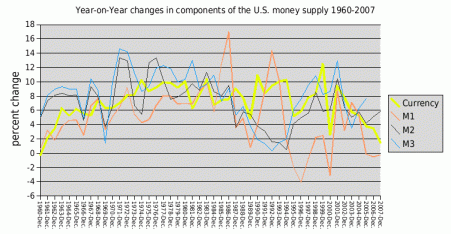
(caption: Notice that M1, paper money and electronic money in US banks, shrinks (goes below 0 growth) from 2004-2008)
Notice that the most important line, the red M1, goes below zero (to shrinking money), and stays negative longer than it had been at any but one time in fifty years. And currency (actual paper money) falls lower than ANY time in that span.
This is because M3, which includes money in foreign banks, was going up so quickly: Money was fleeing the US because of our wars, and the 700% inflated oil prices, and our billions in new foreign aid. We would buy oil that should have cost a few hundred billion, but instead cost us trillions, and send the money for that oil to Saudi Arabia, and other foreign countries.
Over the course of four years, this added up to a shortfall of between two and three trillion dollars in the domestic US economy. That money was all overseas.
Here comes deflation
(caption: The Fed's monopoly could never work better than any other monopoly, and now it's produced deflation)
This didn’t even leave enough money to pay for our normal goods, much less allow the economy to grow…plus, of course, the cost of making things was shooting up from the high oil prices, as all things require energy, while there was LESS money to cover that universal new expense.
The result? Deflation, and therefore a money shortage, that led to the economic depression starting in 2008. There was not enough money to run the economy, so prices began FALLING, the US suffering what appeared to be a “loss” of about three trillion dollars. This was simply the change in prices to represent the trillions missing because of M1 shrinking for four years.
The Federal Reserve’s response? It actually CUT its offered money supply in 2008, by refusing to lend to banks suffering financial trauma…once again failing to act in its sole official role of “lender of last resort” as in 1907.
But it couldn’t keep that up, because deflation destroys a market economy.
So, once this cutting off of emergency money caused the banks to start failing, the Fed belatedly loosened its purse strings: It lend out over two trillion dollars to financial institutions, in just a few months.
Is It Enough to be Hyper?
Now if the Fed did this all the time, lending out a trillion dollars each month when the economy was just fine, we might really have hyperinflation.
But, instead, the Fed did this ONE TIME, starting from a money deficit of three trillion dollars.
So, in fact, what it did was produce enough new money to, hopefully, make up for the money shortage.
Being down trillions of dollars, then adding two trillion, could not make prices double every year. Or even once.
Even if there had been no shortage, two trillion is not enough to increase prices by 50% every month, nor 100% every year, because it is a fraction of the many trillions of dollars in our economy, and only happened one time. Hyperinflation requires more money to be printed even as prices are going through the roof, so that people come to expect it and overprice things ahead of time.
But, even if it had been enough to cause hyperinflation, there’s one last big factor:
Time delay.
How Long?
We can’t guarantee that there will be NO backlash from this infusion of money, until about 18 months have passed. Historically, changes in money supply take between 6 and 18 months to hit prices in an economy. It has to gradually spread throughout the system, being spent, invested, and saved over and again, until its full impact is felt and absorbed.
So we have until mid 2010 to see whether there are SOME effects from the unhealthy throwing of two trillion unearned dollars at our socialized banking institutions.
What About Government Spending?
For better or worse, it is actually impossible for government spending to “stimulate” an economy, at all. And since the current “stimulus packages” are financed by bonds and deficit, not the printing of money, they are actually DE-Flationary. Read the above link, to understand exactly why these things are so.
Sorry, Not Even Close
But, ultimately, whatever backlash there is, it cannot be hyperinflation. With an economy of, depending on how you count, eight to twelve trillion dollars, you can’t make prices jump even 50%, even for ONE month (and it must keep happening, to be hyper), by printing two trillion new dollars. Not even if there were not already deflation to counter.

The great danger, to this day, is deflation, not inflation, which can produce a long-term spiral of economic depression. What's worse, is that the Consumer Price Index, adjusted to compensate for annual cycles like Christmas spending and winter energy prices, showed deflation six months earlier than this chart.
It’s OK if it Kills People

(caption: Standing by a minicar, crushed in a test against a mere mid-sized car: "The laws of physics can't be repealed. Even with modern safety features like multiple air bags, people in small, light cars are always at a disadvantage in crashes." -- Russ Rader, Insurance Institute for Highway Safety (click picture to see video))
It’s bad enough that new gas mileage standards will cost the already-struggling US automakers at least $21,000,000,000 per year, which they will pass on to YOU, either in as consumers or taxpayers, but they also can TRIPLE the chance of your family dying in a car crash.
The new CAFE standards require automakers to have a much higher average gas mileage within a few years. But since automakers can’t force people to buy smaller cars, this means they must stop making larger cars, in order to force the “average” bought to be more efficient.
GM, for example, is going to literally stop selling the Caprice, one of its most popular and longest-made cars, to regular people…because it’s large. It will only offer those to “fleet” buyers, like police, taxi, and limo companies. Each company will also make the cars it does offer smaller and lighter. You will have no choice but to buy these, if you want a new car.
And, of course, you will be forced to finance this change through your taxes, with the new Cash for Clunkers law, while Cap and Trade (if you let it pass) will cause more car shrinkage and insane tax burden on you than CAFE and Cash for Clunkers combined.
Forced Green = Death

(caption: You're three times more likely to die in a small vehicle than a large one)
Yet no expert seriously denies that smaller cars are far more dangerous than large cars. They may refuse to use those exact words, but crash test results like this are not just normal, but a question of physics.
When a car hits something, its size, weight, and the materials out of which it’s made decide how much harm will come to its passengers. This is true even when an immobile object like a fence or tree…but it’s most true when hitting a moveable object, like a deer or another vehicle. These factors determine how much of the energy goes to moving the object you hit, and how much to crushing your body.
Even if your car has a rigid steel frame (Smart cars) and crumple zones (European cars), the change in speed from hitting a heavier object will snap your body around and kill you.
So when Barak Obama and John McCain attempt to force through standards that will effectively ban the building of larger vehicles for families, they are condemning many people to death. But, they say, this is worthwhile in order to force greater fuel economy on regular people.
Efficiency is more important than human life.
In 2004, a study by Dynamic Research, Inc. found a a 20% change in the weight difference between two vehicles in a collision produced a 15% change in mortality. The motivation, of course, was to show that people needed to be forced to drive lighter vehicles; punish SUV owners by reducing the side of their vehicles…but a more rational way to look at it is that, since large vehicles (and deer, and trees) will not cease to exist, a 20% reduction in the weight of new cars means a 15% increase in the death of families riding in them.
Your Death: A Risk They’re Willing to Take

(caption: Never fear; Barak will remain safe in his gas-hogging limosine)
Not only will there continue to be industrial vehicles, tractor-trailor rigs, and other necessary vehicles on the road to hit your shrinking family car, and not only will the deer you hit not be on a corrresponding diet, but bear in mind that the “fleet vehicles” the politicians use are effectively exempted. So Obama, McCain, government officials, and their loved ones will still be safe in their gigantic limosines, massive taxis, and ponderous police cars, to collide with and crush we mere mortals.
Statistically, you are twice as likely to die in a small car than a larger one, during a crash…THREE times as likely, if it’s a single-car crash. That’s right; you don’t have to hit an SUV to die from driving a small car: The more your car weighs, the more it can push back against the object it’s hitting, reducing the speed at which your body is jerked in an accident.
In fact, in a recent test by the Insurance Institute for Highway Safety, smaller vehicles even proved doomsday devices in crash tests against mere mid-level vehicles. It’s not just that a smart car will kill you if it collides with an SUV, but even a normal sedan…and when the new laws are in effect, the normal sedans being made then will be death traps against one made today.
So if a Cap and Trade politician’s limosine crashes into your family car, a few years from now, you (not he) will be far more likely to die than today…but that’s ok, it’s a chance he’s willing to take.

The Mid-sized sedan is slowed moderately by the impact, but the minicar reverses direction in a fraction of the distance. Outcome: Sedan's driver; pissed off, smartcar's driver; dead
Why Stimulus Spending Depresses the Economy
There is a good reason why Bush’s “economic stimulus” plans helped land us in economic depression, and why Obama following that precedent with bigger, badder stimulus plans will do even more harm.
It is the same reason why Japan’s “stimulus plans”, upon which ours were partially based, kept them in an economic depression for a decade, and did the same thing in Sweden.
Here’s How
- Lost Money: Every penny spent is taken from the private sector: whether through taxes; or by borrowing that robs from private investment, so nothing is gained. Then that money is wasted before it’s spent, because of the cost of bureaucracy, red tape, political motivation, and the lack of any control over the benefit of what it’s spent on.
- Crowding Out: The government spending competes with private spending, but has no checks or balances, no responsibility, so that it can crush the private competition out of the market, causing more economic harm instead of helping. It hires away workers and managers with large budgets, yet contributes less. It draws away research and investment from the private sector, et cetera.
- Chilling Effect: Healthy private investment and behavior is seen as punished, as unconditional public spending displaces it. Government spending tends to reward failure, and not to create wealth, while private spending depends upon productivity and success to expand. Bad companies, which do not contribute enough to society to justify their existence, have their ineffective ways perpetuated, instead of being excised and replaced with new competition.
Lost Money
Your Neighbors
 Your neighbors are planning to upgrade all of their crappy single-pane, wooden windows to nice thermal-pane replacement windows.
(Don’t ask how I know, just work with me, here…)
Your neighbors, therefore, shall cause the full employment of a team of six carpenters/installers, for one week. And those workers will, in turn, use their pay in ways that end up rewarding others, by spending or investing.
Of course they’ll also be profiting the company that sells windows, which in turn will reward its suppliers by ordering more, et cetera.
Your neighbors will, too, have nicer windows. Their house will be more comfortable. They will save money on their energy bills. And, if they are Global Warming True Believers, they will also feel very good about their effort to save the earth.
All of this benefits society and the economy. Even the feel-good parts.
Big Brother
But perhaps your neighbors will be prevented from doing this, by Big Brotherment.
Maybe their taxes are, or will be, high enough that they won’t be able to afford to buy those thermal replacement windows.
Perhaps, in fact, the amount necessary to upgrade their house will, in fact, be spent on a Stimulus Package, funded by their taxes.
That tax money, instead of being spent on their house, will instead filter through the government bureaucracy. The majority of it will actually be paid to bureaucrats, who produce nothing but paperwork and rules.
What’s left, in theory, will go to some union contractors in Iowa, to finance a Corn Museum. Never mind that Corn makes more money for its producers than any other crop, the government is financing this to “stimulate” the economy.
So a team of three union carpenters will get paid for about five days, based on your neighbor’s tax money. Three, because a majority of the money was lost to red tape, and only five days, because the union monopoly dominating the government contract in question is overpaid.
Better still, once their hourly coffee breaks and four mandatory half-hour breaks are deducted, and you take into consideration the bizarre “safety” rules in their contract, that leave them standing around more often than working, what you will actually get is about the amount of work one carpenter’s could do in five days.
And it will be dedicated to building the 23rd corn museum in the United States.
So the options are:
Free Market
- Your neighbors get a house full of thermal windows.
- Six carpenters get fully employed for a week.
- A window company is rewarded for improving the lives of your neighbors.
- Money is saved on energy.
- The planet is no longer doomed.
Government Stimulus
- Iowa gets 0.01% of a corn museum.
- Three carpenters get employed for five days, to do the work of one carpenter.
- People may, if the project is ever finished using other people’s tax money, get to save an hour over driving to the privately funded corn museum next door in Illinois.
Now a government bureaucrat will, in defense of his precious Pork budget, say “but we can’t be sure your neighbor will buy thermal replacement windows!”
But, quite frankly, we can be just about 100% certain that they will spend it on something they value. I’m not entirely clear on how even pet rocks and full body massages would be any less of a contribution to the economy than another corn museum.
And, seriously, much of the government’s spending benefits society less than corn museums, too.
Bridges to nowhere, two thousand dollar toilet seats, military equipment the generals said they didn’t want, but some senator insisted on funding because it is built in his state, methadone for junkies that is more addictive and toxic than the heroin it is replacing, free benefits for illegal aliens…
Face it, the corn museum was actually an optimistic example of government benefiting society.
Ultimately, each dollar the government spends must come from a dollar ALREADY taken from your pocket, directly or indirectly. There is no stimulation, because it’s just the same dollar. And, worse, YOU would have bought something you felt was beneficial, not wasted it on some bureaucratic make-work project.
Crowding Out

(caption: Buying stuff on closeout from a bankrupt company helps the economy far more than a government check, regardless of whether it saves the bankrupt company)
And let’s not forget that the government’s spending competes with private spending. There is a pressure against private industry, when it’s forced to compete with a government that can forcibly finance a project without any standards for success.
Workers
As noted above, if you are a carpenter, you can get a job where you are paid for what you accomplish, in the private sector, or you can get a job in a government contract where a union monopoly guarantees you more pay, for less work, a coffee break every single hour, and you’re not actually expected to even succeed, or do good work.
With government spending, therefore, one ends up with fewer skilled workers in the private sector.
Research
Better an easy government research job with no results required except regular publication of results, than private sector research, that must actually prove some contribution to society.
This is why things like cancer research and alternative energy research have produced only insanely expensive, ineffective results.
Business
Why build a privately financed corn museum, when there is a public one planned nearby? The free market depends on the pressure of demands, which can be supplied because of the reward of profit, fame, et cetera. All of which is quashed by public competition…producing LESS economic activity, prolonging, or even creating, economic downturn.
Investment
This is even true of investment. Why risk money buying stocks, or investing in any other resource that actually helps create wealth and grow the economy, if the government is issuing trillions in bonds that it can guarantee, at gunpoint, it will be able to afford to pay off?
This is part of why the US stock market is below where it was a dozen years ago; the past nine years of massive growth in government spending have crowded out even investment, depressing economic growth and the availability of money for business and individual use.
Chilling Effect
 Capitalism helps society prosper, in part, by requiring that businesses be efficient and useful, or else be displaced by other, better, more efficient competition. Government “stimulus” spending helps bad behaviors and inefficient companies survive, preventing the openings for new, better ways.
Reward Failure
Government spending, too, has to reward failure and punish success, directly. Not just by bailing out failures, but with its own agencies: It would be irresponsible to expand the budget of a project that was already coming in ahead of schedule and under budget. What a waste of taxpayer dollars! Instead, if the agency wants to expand its budget, it must fail. It must show how it is over budget and behind schedule, and how natural this is, how more money and power will help it achieve its goals.
Punish Success
Meanwhile, responsible, productive businesses are punished for their contribution to society.
What if Ford ends up the weakest of the three automakers, because it didn’t take the thirty billion taxpayer dollars and declare bankruptcy? What does this tell companies in other industries, when they’re considering whether to be productive, or else squander money and go crying to the stimulus committees for bailouts?
Government Gangrene
There are hundreds of billion dollars in bad investments, loans, et cetera, that need to simply fail, because they cannot ever be productive. Right now they are gangrene on society’s body, just burdening our health and slowly spreading…but the stimulus/bailout money keeps them from being removed, and even helps them expand, quashing healthy alternatives.
The Solution
In each case, around the world in history, the only way to get out of economic depression was for the government to STOP killing the economy with its fake “stimulus” packages.
Examples
It took Japan and Sweden ten years to figure this out. Some other countries never have, and still are suffering for it.
Even in the US, the government constantly expanded spending to “stimulate” from 1929 through 1938, and only truly enjoyed healthy economic growth when spending and regulation were massively cut in the late forties and fifties.
The opposite of this was the depression of 1920-21, where banks failed, commodity prices plummeted (like housing prices now), the stock market crashed…and the US government did virtually nothing.
That lack of “stimulus” resulted in a depression less than two years long, unlike the decade of the other examples.
Check out the extensive history of economic downturns in the US, for more.
Self-Transfusion?
Ultimately, government spending actually sucks the life out of the economy, increasing and prolonging economic depression, because it must take private money in order to “spend” the public money…as if you gave yourself a blood transfusion by taking blood your left arm and putting it in your right…with the stress of the transfusion actually leaving you weaker than when you started.
Why Do Good People Hope Obama Fails?

(caption: Hoping The People succeed often means hoping a specific politician's agenda will fail.)
There was a recent hue and cry about Rush Limbaugh saying he hoped that Obama would fail.
But he has plenty of people on his side…from all over the political spectrum. Why?
Look not at the words a politician uses to adorn his proposals, but at the things it will actually produce.
There is a huge gulf between the pretty things Obama promises, and the poverty and tyranny he, like his predecessor Bush, would deliver if successful.
Progressive “Universal health care”, anywhere in the world, produces universally short supply and slow progress of medical technology.
“Renewable energy” has been the promise of government for forty years, but all that it’s ever produced is renewable economic malaise.
“Comprehensive immigration reform” means bundling bad ideas with good ones, for an overall worsening of conditions.
Our economic depression was caused, in part, by high energy prices (because of Bush’s insane foreign policies driving the price of oil up 700%). Now Obama promises to drive up energy prices even higher, on purpose, in the name of “global warming” that ignores the past two years of global cooling…and we should wish him to succeed?
Canadians illegally sneak to the US to get health care, when suffering or even in danger of death, because it can be months, or even years, before their own system rations out treatment to them. Britain actually bans life-saving treatments it deems “too expensive”. You’re not even allowed to buy them for yourself, much less get them “free”. The whole problem with US health care, in the first place, is that government has been increasing the “universal” and “free” parts for over forty years, stripping consumer control from our hands, causing prices to go up and service to plummet…would we really hope Obama manages to make that rationing universal?
There are debates, in America, over:
* Whether jobs should be protected from new immigrants, or they will increase wealth and demand enough to be a net plus
* Whether people who have broken existing laws in order to sneak into the country, by tens of millions, should be given blanket amnesty, or have to go back home and start over legally, or simply be thrown in prisons or exiled permanently.
* Whether tax-paying, productive people should be forced not only to subsidize poverty and failure among formerly tax-paying Americans, but even for foreigners who show up illegally just to get the free handouts, as is helping bankrupt California right now. Should their children suffer for their wrongs, or just the children of people who pay taxes?
All of those debates should be settled, separately. Lumping separate issues together to force people to take the bad ones in order to have the essential good ones is one of the great crimes of modern government.
But we must hope he succeeds in this?
That’s not the kind of “hope” people voted for in 2008.
We hope THE PEOPLE succeed…which often means hoping a specific politician’s agendas fail, completely.
Hypocritical Car Dealers’ Whining…

(caption: This car dealer whines about how a car company should not be allowed to lay him off, and then talks about how he laid off 35 employees)
Oh no, the bankrupt automobile manufacturers are ending their association with two thousand car dealerships!
This is unacceptable, because bankrupt companies should never cut costs, nor do anything else to become efficient and remain in business. They should keep all of their employees, business associations, et cetera, even if it means continuing to lose money and vanish entirely within the year.
On the other hand, why are these hypocrite car dealers not doing the same thing?
The ones pandering to a grandstanding Congressional panel today complained that they — the dealers themselves — had to lay off dozens of employees.
One of them said something like “I have been turned into a glorified used car dealer, which…[sob]…cost thirty-five of our loyal employees their jobs! [whimper]”
But…but…why on earth did he not simply keep all 35 of those employees, the way he’s demanding the automaker be forced to keep his dealership?
Every single explanation he might give, if asked this, would translate into an argument for why the automaker needed to get rid of extra dealerships.
Of course, the automakers could have kept more dealerships, if the Obama administration were not undermining their ability to get out of insane contracts with the UAW monopoly.
But, either way, the automakers are SUPPOSED to cut costs, at the cost of jobs and associations.
Or else the car dealerships should not be laying off employees, just because they lost their new car contracts.

And now we see another consequence of the Bush/Obama nationalization of industries...
Fowl-Weather Conservatives?

Beware the Republicans in Name Only, who adopt Conservative jargon only when safely out of power, but believe in socialism.
Listening to all the “Obama is a socialist, someone save us from the fascist state” hubbub going on now from the neocon pundits and politicians, you wouldn’t guess that, for six to eight years, the Liberal/Neocon wing of the Republican party controlled all important aspects of government, and acted almost exactly like Obama is now…if anything, worse.
Where were these frauds, when Bush was the one nationalizing banks, passing huge bailouts, expanding regulations to record size, socializing health care, et cetera?
Why are fake Republican pundits suddenly talking Conservative now, when they were talking Liberal then?
Because now they’re out of power. Impotent, they feel safe arguing for the liberty they despise, simply to get back into power…at which point, history says, they would simply expand government faster than the Democrats.
This happened when Nixon replaced Lyndon Johnson. He signed more Great Society bills into law than his predecessor.
The same thing happened with Bush following Clinton; he expanded domestic spending more in any ONE YEAR than Clinton did in an entire four-year term.
His solution to the Katrina disaster? Throw money at the problem, even when the corrupt Louisiana and New Orleans governments had already been given, for a decade, more Corps of Engineers money per year than the rest of the nation, combined.
When recession hit, or years later depression, both times their “stimulus” packages were Keynesian socialism, even the fake “tax cuts” mostly being socialist tax credits and semi-annual welfare payments disguised as meaningless “rebates” that did not change economic behavior at all.
When Bush crippled our economy with huge new regulatory schemes in health care, shipping, and insurance, these faux-Conservative talking heads were silent, defended him, or even bragged on it.
When he expanded socialized health care more than ever before in US history, with the prescription drug “coverage” that inevitably caused the price of prescription drugs to explode, why were they not screaming “socialism”?
When Bush said that he was banning guns in occupied Baghdad NOT to repress the resistance fighters, but only to “reduce violent crime”, parroting Liberal gun control freaks’ excuses, why did they not scream in horror? Obama has actually spoken more in DEFENSE of the second amendment than either Bush or McCain, and yet they claim he’s trying to confiscate all guns.
Let’s face it, the neocon Liberals in the Republican party leadership, and much of the “Conservative Media”, including talk shows and Fox News, don’t believe a word of what they are now saying. They are, if anything, worse than the Liberal Media…their advocacy expanded government and attacked liberty far more successfully than the Democrats have.
Let’s not get sucked in by their “rebranding” scam.
Like super-Liberal RiNO Bob Dole said, when opposed by all true Conservatives in his 1996 run for the presidency, “if you want a Reagan, Bob Dole can be a Reagan”…to them, it’s all a game of packaging and playing at what true Conservative supporters of liberty believe.
Secrecy is Tyranny
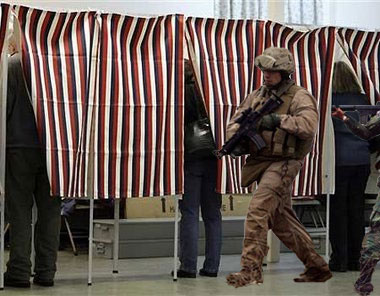
(caption: Keeping secrets from voters is exactly as coercive as holding a gun to their head in the voting booth)
Secrecy, even in and of itself, is a form of tyranny.
No, this doesn’t mean when you don’t tell your friend about his surprise party, nor concealing the recipe for Coke Classic, not even the hidden initiation rites for that fraternity…
But when you cause someone to do something they would have otherwise not chosen, because you conceal information from them, then you are coercing them, the same as if you pointed a gun at their head.
And, in the case of government, when the People are supposed to control policy through elections and popular support, any government-concealed information that changes how they would vote is tyranny, same as if they sent stormtroopers to help fill out ballots on election day.
Any pundit you see complaining that a government official told the American public too much is, in effect, advocating tyranny.
It’s one thing to hide when troops are making an attack for a few days, or to openly refuse to tell exactly how a nuclear bomb is made…but it’s another, entirely, to conceal information that will change how people vote, no matter what “national security” excuse they invent.
This is most painfully transparent when the actual “national security” excuse is “this will embarrass [some government official or office]”. Embarrassment, shame, and general changing of how someone sees something are obviously not legitimate excuses. What’s more, it would not matter either way, because that is the price of liberty.
America is supposed to be a free country. This requires responsibility for the consequences of one’s actions, including when it means something embarrassing, whether to your neighbor or the foreigners who will be horrified or disgusted at our government’s behavior.
In fact, without secrecy, many of those evils would not occur in the first place, just as in our real lives. If the government can’t hide when it bribes a foreign official, or tortures someone, or other evils, then it will face public and international shame, and the threat of voter retaliation, and hopefully not do it in the first place.
By preventing voter retaliation, a government does not make itself more stable…just more tyrannical.
Unamerican Policies Are Great Tiger Repellent
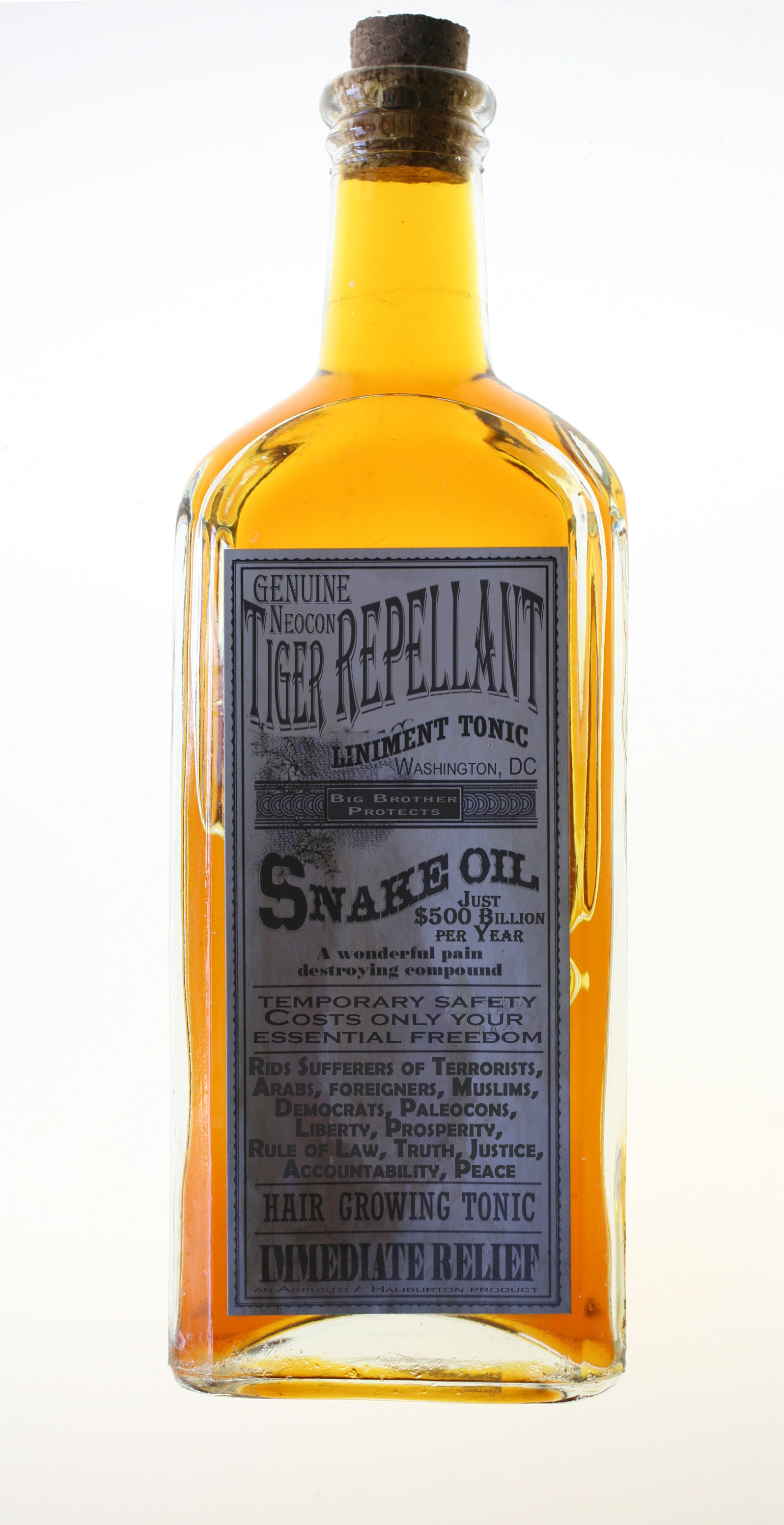
We didn't get attacked for the ten years prior to 9-11 either.
Little Old Lady: [Long Island Accent] This tiger repellent is so expensive, I may have to cut back on my groceries to keep getting it!Sane Person: But…tiger repellent is a scam! Why would you buy such a thing? It’s a waste of money!
Little Old Lady: Well, I started buying it when that magician got mauled. And obviously it works; I haven’t been attacked by a tiger, since!
No matter whether Bush’s policies violated every American principle or not, one thing you can definitely say is that we haven’t had a terrorist attack on US soil in the seven years since he started them.
Nor have we been attacked by tigers.
In fact, we did not have a terrorist attack on US soil for almost ten years BEFORE 9-11. Crediting Bush’s violation of every American and Conservative principle with this “safety” is actually somewhat more foolish than the little old lady buying tiger repellent.
Unless it actually attracts tigers.
Because Bush’s evils, committed in our name, like:
- Torturing now-helpless captives
- Attacking countries without provocation
- Rounding up people at random from suspected areas and keeping them for months, or years, without outside contact or even determining which ones, if any, are actually the targets
- Handing out billions in cash and military supplies to top state sponsors of terrorism like Pakistan and Saudi Arabia
All have increased likelihood of attacks against America.
It is no coincidence that terrorist attacks worldwide increased with each implementation of these policies. That they didn’t happen in the US is because zero times some amount is still zero.
These evils are a perfect recruitment system for terrorism. What other way do these people have to stop us? Would YOU not fight back, if these things were being done to your family?
Evils we would not normally commit, we should not commit just to gain some benefit…but especially when the benefit is imaginary. “We haven’t been attacked since 9-11” is as ridiculous as “I haven’t been attacked by a tiger since Siegfried and Roy were attacked”.
Thank Liberalism for the SUV…again

(caption: You can't ban powerful vehicles, any more realistically than you can ban stupidity.)
Years ago, busybodies decided to violate the limits to the powers of the Federal government, by setting gas mileage standards (and many other harmful regulations) on automobiles.
As is always the case with the Law of Unintended Consequences, this actually produced the opposite of the intended results.
It created the green-hated SUV boom.
This is because there are legitimate uses for large engines, and large vehicles. You can’t just declare that everything has to get X miles per gallon. Obviously, trash trucks cannot. The tractor-trailer rigs that deliver most of our goods cannot. Vehicles that actually are needed to drive somewhere on the road and then go off-road to do work cannot.
There are, in fact, many sporting or work activities that require the power or weight that make high gas mileage impossible.
So the bureaucrats were forced to create special exceptions…for example, a Sports-Utility Vehicle class.
But arrogant, ivory-tower civil rulers cannot anticipate all needs. OK, let’s face it, they are actually incompetent at anticipating the needs of real people.
So it didn’t occur to them that regular families need large vehicles, for many reasons. Nor that the regulations on minivans would make them too underpowered and, well, ugly, for most people to find tolerable.
So, in fact, the typical family was faced with an artificial division between the “efficient” vehicles, and those even more powerful than they need.
They were, therefore, actually driven (no pun intended) to buying from the latter class. Stuck between feeble, dangerous, ugly cars with good mileage, and inefficient, powerful, good-looking ones, they chose the latter. As they should.
It’s the environmentalists’ own fault.
And now they’re at it again:
The Obama/Pelosi administration have announced a McCain-like plan to FORCE Americans to drive even weaker, uglier, more fuel-efficient cars. This will not only increase poverty, by hugely raising the price of cars and therefore pricing people out of transportation, but will surely have many other unintended consequences, in the long run. More automaker bankruptcy, as they’re forced to make cars we won’t buy? Even crazier automotive trends, as we try to find a way to get what we actually need, instead of what they want us to have?
Have fun finding out what they’ll be.
Stop Blaming Capitalism: for Socialism’s Failures
New, Permanent Home!
This article has garnered such overwhelming response, that it has been given a permanent place, here.
The page below is now only a quick summary, with the details and citations moved to the real page.
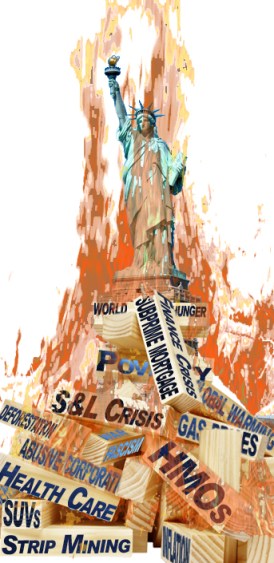
HMOs, the health care crisis, strip mining, robber barons, deforestation, SUVs, “global warming”, world hunger, unemployment, inflation, periodic recession/depression…what all have in common is that Big Government is the cause, but your economic freedom is blamed.
Politicians tend to force bad government programs on us, which then have destructive side-effects, usually the opposite of what’s intended, and then saying the effects were caused by whatever freedom of choice is left over, and trying to take that away.
Included in the list of such failures:
- HMOs
- The Housing Market / Sub-prime Mortgage Bubble:
- SUVs
- The Savings and Loan Bailout
- Bailouts
- Robber barons, Strip Mining, Deforestation
- Corporations
- Monopolies and oligopolies
- Oil / Gas Prices
- Energy Prices
- Hunger
- Automaker Bankrupcy
- Alternative Energy
An entire group founded around this topic, including extensive discussion of it, can be found at Stop Blaming Capitalism, for Socialism’s Failures

(It's amazing how many things government forces on us, which are then blamed on our freedom)
About
 This site has its origins before the word “Blog” existed. Back then its owner, Kaz, was simply thought of as having a website that published socio-political articles with regularity…But the only real difference was that the RSS/XML protocals were not yet used this way.
The website was known as Site of the Sentient, a reference to the famous Words of the Sentient, that Kaz had been editing for years previously.
When some random portal site hijacked the domain siteofthesentient.com, it was a dark time for the human knowledge quest. Fortunately, But Now You Know is striving to take up the slack, and even has some revamped versions of the original articles, for example Conscription, is it Slavery, and How to Get Out of Jury Duty, and be a hero instead of a bad citizen.
Kaz is a writer, graphic artist, and supplements his income by being a hardcore senior web developer.
Along with this blog, you can track his efforts with the dedicated facebook page here.
Speaking of tracking:

You can follow But Now You Know here, on Twitter

And you can follow But Now You Know, via our Facebook Page, here.
Share This Article

 Words of the Sentient
- Tolkien, on Government
- Criminals Are Never Disarmed — Robert Heinlein
- Power Attracts the Corrupt — Frank Herbert
- Under Democracy — H.L. Mencken
- Guard Your Enemies from Oppression —> Thomas Paine
- Your Right to Not Support Evil
- Global Warming Shamanism
- The Squeaky Wheel…May Be Foolish
- Disarming the Victims
- The Inconvenience of Too Much Liberty
Recent Comments
- Pithy Pontifications
- An error has occurred; the feed is probably down. Try again later.


 But Now You Know