The Truth about Income Inequality
There has been a lot of hoopla, lately, about the gap between rich and poor, how it’s growing, and how we need to give government more power to get rid of that income disparity. It’s actually been shrinking for the past four years, but it’s still larger in the US than most countries.
Some people say that it’s proof capitalism doesn’t work and needs to be banned, or at least that we need more income redistribution. Otherwise, the masses may revolt, like they’re doing in Greece and eventually take everything, therefore the ruling class have to choose between being violently overthrown, or surrendering their wealth.
But this all begs the question of why we’re talking about income inequality in the first place. The real question is whether we should be talking about differences between people, or overall quality of life for everyone.
Should We Care about the Wealth Gap?

Bolivia, Haiti, and Congo have very low income gaps, but equally low standards of living.
Which would be better:
- A society where the wealthiest earn a certain amount per year, and others earn about 50% that much.
- A society where the wealthiest earn a certain amount per year, and others earn only 5% of that much.
If you answered either way, you’ve blown a test of basic logic; You have no way of knowing which is better, unless you know how well the poor are doing in real-world terms.
For example, let’s say you answered that (1) is better, where the wealthy earn only twice as much as the poor, instead of twenty times as much.
But it turns out that, in the two examples:
- The wealthiest earn $20,000 per year, and the others $10,000
- The wealthiest earn $1,000,000 per year, and others earn $50,000
Would you REALLY prefer that the poor only get $10,000 per year, instead of $50,000 (in dollars with the same buying power), just because the income gap is smaller?
Not if you have any real-world experience. I’m sure a few kids who’ve never had to live on their own, or guilt-ridden trust fund brats convinced that everyone being poor is better than some being really rich, but the rest of us know better.
And when people talk about The Gap Between the Rich and Poor in the US, claiming income disparity is a horrible thing that needs to be fixed, this is exactly the kind of foolish, self-destructive position they’re taking.
Socialism vs Capitalism
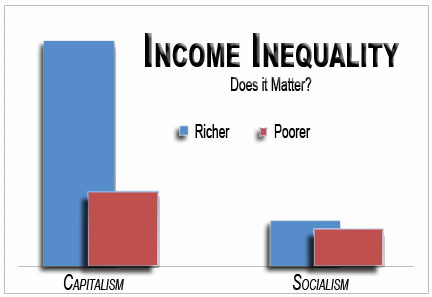
Who, but guilt-ridden trust fund brats, seriously would prefer for the poor to live with less, just so the rich would have FAR less?
In fact, as the above examples show, what matters can’t be the “gap”, but the actual quality of life of people in the society.
Take Communist China, for example:
- When China was much more socialist, redistributing wealth and regulating the economy with “social justice” the way the “income inequality” people want things to be, most people in the country were miserably poor…but equally so. They struggled just to subsist, living on dirt floors, literally millions dying from lack of resources that should have been readily available…but there was almost no wealth gap, at all.
- When the government realized that socialism doesn’t work, and began deregulating the economy, the gap between rich and poor exploded. It’s now hundreds, maybe thousands of times “worse” than it was…but almost everyone in China the less-regulated parts of China is better off than they were, although some are now MUCH poorer than the wealthiest.
The decline of socialism has led to a better life for many of the poor, and an increasing wealth gap, purely because some of the poor, themselves, are becoming much wealthier.
It is not income disparity that matters, but actual standards of living.
Far fewer people in China are now dying of hunger. Many of those who lived in huts with dirt floors and delivered their babies standing up in the kitchen now have modern homes and medical care…because of the very mechanisms that are making income disparity greater.
What we really need to be concerned with is quality of life, not exploiting jealousy and greed by focusing on “inequality”.
Rising Living Standards
When people claim that something forceful needs to be done about people they describe as poor, they make it sound like those people are victims of capitalism, now reduced to poverty.
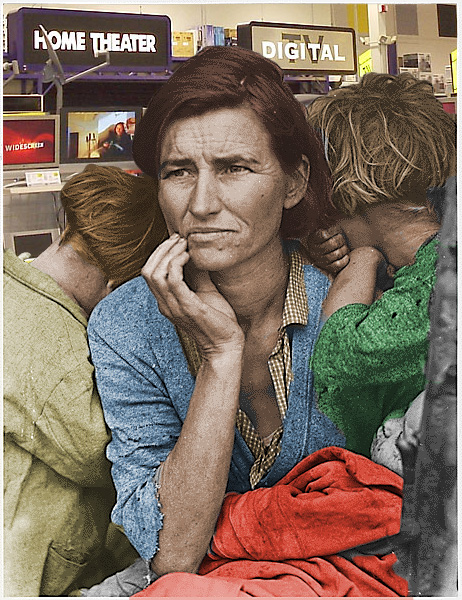
The more we have, the more we want…we shouldn’t let that translate into jealousy and greed against those who have more
For example, think of people who complain that, thanks to the Roaring Twenties, one third of all Americans at the time had no electricity, indoor plumbing, access to automobiles, et cetera…but, of course, a decade earlier even fewer people had electricity, indoor plumbing, or automobiles.
In fact, just a few years earlier dirt floors were normal in the US, just like China. The very idea of what is “ill-clothed, ill-housed, and ill-fed” had shot up in standard purely a as result of the “unfettered capitalism” of the 1920s.
If not for that period of economic freedom, dirt floors and cheap, crappy clothing, and malnutrition would have still been considered normal and adequate.
Likewise, you can find people talking about protests over living standards in China, now, where they focus about the slums around the big cities, how people don’t have gas heat, live in cramped conditions, et cetera.
But, of course, just a few years ago, most of those people were peasants living in dirt-floored huts, eking out miserable lives wading in rice paddies, barely growing enough to feed themselves after the government confiscated most of their product of labor, and living on barter.
They moved to those slums because, as in Industrial Age America’s “sweat shops” it’s an improvement over what they had before. If China continues to deregulate, their living standards will continue to get better, even as their idea of how they should live increases faster, making them complain more.
One of the greatest political scientists in history, Joseph Schumpeter (with a name like Schumpeter, he had to be good) actually thought that the doom of Capitalism might simply be that it caused things to get so good that people’s idea of what they deserved would outpace how much better things were actually getting, so that they would always turn to massive government intervention to “fix” it, causing the economy to fail.
This is what happened with Herbert Hoover’s massive spending increases and regulation causing the Great Depression, and is happening now.
Some Wealthy Did NOT Earn their Money, and Need to Lose It!
But it’s true that things are unfair, today. There are many people who do not deserve the wealth they have. They did not earn it themselves, but used bailouts, “stimulus”, corporate welfare, and other coercion to steal money confiscated from others. Their corruption and inefficiency has been preserved, like a limb with gangrene, and is killing the body of the economy…like a limb with gangrene. And that needs to end, yet both dominant political parties are actually defending and increasing this economic injustice.
Instead of obsessing with the jealousy and greed of class hate, comparing who has what and trying to take away from those who produce more, we need to increase the very conditions that cause “income inequality”, to allow the poor to increase their own well-being, even if the rich increase theirs even faster…but stop actively rewarding the wealthy through government fiat, when they haven’t earned it.
We should let bad companies and people fail, therefore increasing social justice, if not income equality.
BONUS FEATURE:
Here is the original article from the Site of the Sentient, written in 1996: Income Disparity: The Gap Between the Rich and the Poor
9 Comments »
Leave a reply to kazvorpal Cancel reply
About
 This site has its origins before the word “Blog” existed. Back then its owner, Kaz, was simply thought of as having a website that published socio-political articles with regularity…But the only real difference was that the RSS/XML protocals were not yet used this way.
The website was known as Site of the Sentient, a reference to the famous Words of the Sentient, that Kaz had been editing for years previously.
When some random portal site hijacked the domain siteofthesentient.com, it was a dark time for the human knowledge quest. Fortunately, But Now You Know is striving to take up the slack, and even has some revamped versions of the original articles, for example Conscription, is it Slavery, and How to Get Out of Jury Duty, and be a hero instead of a bad citizen.
Kaz is a writer, graphic artist, and supplements his income by being a hardcore senior web developer.
Along with this blog, you can track his efforts with the dedicated facebook page here.
Speaking of tracking:

You can follow But Now You Know here, on Twitter

And you can follow But Now You Know, via our Facebook Page, here.
Share This Article

 Words of the Sentient
- Tolkien, on Government
- Criminals Are Never Disarmed — Robert Heinlein
- Power Attracts the Corrupt — Frank Herbert
- Under Democracy — H.L. Mencken
- Guard Your Enemies from Oppression —> Thomas Paine
- Your Right to Not Support Evil
- Global Warming Shamanism
- The Squeaky Wheel…May Be Foolish
- Disarming the Victims
- The Inconvenience of Too Much Liberty
Recent Comments
- Pithy Pontifications
- An error has occurred; the feed is probably down. Try again later.


 But Now You Know
Our free-market system, improperly known as Capitalism, is demonized by many of our citizens, many of our politicians, and much of the rest of the world. But in our formative years we tried a form of communism or socialism – long before Karl Marx was born, and those countries who now espouse it were formed. It was a miserable failure, and the history of its failure is revealing.
The Beginning
On August 1, 1620, the Mayflower set sail for the new world from England. It carried 102 passengers. Forty of them, Separatists, led by William Bradford had left England to escape the oppressive Church of England in search of a home where they could live and worship God according to their own conscience. The others sought the New World for other reasons. Together, the group became known as the Pilgrims.
Most history texts do not convey the fact that the contract the Pilgrims made for a loan with their merchant-sponsors in London, needed for the expenses of the voyage, specified that all the land they cleared and the structures they built would belong to the community and everything they produced was to go into a common store, with each member entitled to one common share. If you worked hard and were successful, the fruits of your labor went into the common pool and everyone, including those who couldn’t work or chose not to work hard or at all, shared equally from the pool and your labors. And you didn’t own your house or benefit from the good work you did on your land. It all belonged to the community. This sounds like actual equality for all, that many of our politicians talk about, and others espouse for the people of the United States.
This was actually early communism or socialism. The principal definition of Webster’s Encyclopedic Unabridged Dictionary, 1989, which I have, for communism is: A theory or system of social organization based on the holding of all property in common, actual ownership being ascribed to the community as a whole or to the state.
The definition for socialism: a theory or system of social organization which advocates the vesting of the ownership and control of the means of production, capital, land, etc. in the community as a whole.
These forms of government have been promoted since the second half of the 19th century as forms of a classless society, good, based on common ownership of the means of production. The Pilgrims’ agreement formed that type of government; the only difference from those definitions, was: After seven years in the new land, all would be divided among the inhabitants – the common stores, land, livestock, houses, etc.
Socialism and communism were brought to the attention of the world by the works of Marx and Lenin, in the 1840s. The problem they were trying to solve was a problem that the Pilgrims had already solved, and the Pilgrims showed that Marx’s and Lenin’s methods failed, miserably. We will cover this in detail as we move along.
The Mayflower passengers were headed for Virginia, but they strayed off course and wound up in New England – on Cape Cod, outside of the territory covered by the English King’s Charter. They were in territory not controlled by any King’s government, commands, and edicts, so it was necessary for them to establish their own governance. They did so, and it was called the Mayflower Compact. This became the foundation for the world’s first free nation – a government of the people, and the first free market in the world then evolved; this helped guide the Founders in their efforts to found a free nation with a free-market economy, which became the United States of America.
…The Mayflower Compact was not a constitution but rather an adaptation of a Puritan church covenant to a civil situation. Furthermore, as a provisional instrument adopted solely by the colonists, the document did not solve the matter of their questionable legal rights to the land they settled. (A patent was eventually obtained from the Council for New England in June 1621.) Still, the Mayflower Compact became the foundation of Plymouth’s government and remained in force until the colony was absorbed into the Massachusetts Bay Colony in 1691. Although in practice much of the power in Plymouth was guarded by the Pilgrim founders, the compact, with its fundamental principles of self-government and common consent, has been interpreted as an important step in the evolution of democratic government in America…
…Mayflower Compact, document signed on the English ship Mayflower on November 21 [November 11, Old Style], 1620, prior to its landing at Plymouth, Massachusetts. It was the first framework of government written and enacted in the territory that is now the United States of America… (Italic added)
https://www.britannica.com/topic/Mayflower-Compact
They formulated the Compact before leaving the sanctuary of the Mayflower and heading for land on November 11, 1620.
The Pilgrims dropped anchor in Plymouth Harbor and settled in an abandoned Wampanoag Indian village called Patuxent on Dec. 20, 1620. When they reached land, a cold and barren wilderness greeted them on that day. No friends, no houses, no stores for food, and as time passed, half the Pilgrims died of starvation, sickness, or exposure. 45 members died the first winter (1620-1621)
They built houses, made friends with some Indians, hunted, farmed, and in late September, early October 1621, they celebrated Thanksgiving with some Indians. According to Bradford, they hadn’t prospered, but they had managed.
When spring arrived, an Indian, Squanto, taught the Pilgrims how to plant corn, to fish, use fertilizer, and stalk deer. Bradford wrote that Squanto was “a special instrument, sent of God, for their good beyond their expectations.” The following October, after their first harvest, Bradford, who in the meantime had been designated Governor, set aside a day of thanksgiving. Squanto, his chief, Massasoit, and other members of the Indian tribe were invited to the feast. Its purpose was not to thank the Indians or Mother Earth, as contemporary history books commonly report: It was a devout expression of the Pilgrim’s gratitude to God. Subsequently, exploration led the Pilgrims to Plymouth for a more suitable, permanent location.
In November 1621, the ship, Fortune, brought in 35 more settlers that had to be accommodated. On the Fortune’s return to England, the ship was loaded with good clapboard and two hogsheads of beaver and otter, a cargo they judged worth £500, but it never reached England; a French privateer seized it (according to Bradley’s files).
They continued with weakened conditions until 1623. They had had enough to subsist, and by this time the population had grown to 180. However, the communal conditions under which they had agreed to obtain the loan had become intolerable; Gov. Bradford described the results of living under the rules of community sharing. Here it is, revised from old English:
Contrary to Plato’s, other ancient’s philosophers, and some others of later times: The sharing of property and distribution of all individual production into the community for equal sharing did not make the community a happy and flourishing one. It bred confusion, discontent, and retarded much work that would have benefited the community. The young and most able rebelled at spending so much of their time and strength in working for other men’s wives and children, without any additional pay. The strong men felt that it was an injustice that they received no more in the distribution of food and clothes than that received by the weak who were unable to perform a quarter of the strong man’s efforts.
[He didn’t mention the slackers – those never inclined to work hard — but I am sure there were some.]
In 1623, William Bradford, then Governor of Plymouth, with advice from others of importance, departed from the bargained loan agreement made with the English because of extreme dissatisfaction. He assigned to every family a parcel of land proportioned to the number of individuals in it – and the land was theirs. And he distributed the children and the weak with no family connections to live with those who could accept them, along with their parcels of land. He ruled that every individual should plant and cultivate as much corn and other products as they wished, and the fruits of their labors were theirs — and theirs alone — to dispose of as they pleased.
Bradford’s departure from the English loan’s stipulations, his democratic rules for Plymouth, and the freedom he gave to the people allowed the free market to begin and to flourish. The same type of governmental rules, because of their successes, were those employed and built on by the Founders
Bradford wrote of the changes this wrought (again, revised from old English): “This had very good success, for it made all hands very industrious…. The women went willingly into the fields and took their children with them to plant corn. The community looked at the use of children with different eyes at this point. Previously, to use children in the fields would have seemed a form of tyranny and oppression.”
The changes allowed the people to work together with friendliness and, with hard work, to provide for themselves a decent living. In 1625, the Pilgrims found they had more food than they could eat, so they set up trading posts and began exchanging goods with the Indians. And they were dealing in beaver and other fur trades.
Apart from home plots, acreage was initially assigned on a yearly basis. In 1627, every person was assigned a permanent, private allotment. The venture’s assets and debts were divided among all the Pilgrim colonists, with each person receiving one share (twenty acres of land and livestock) and heads of families receiving one share per family member. Farming proved productive enough to have made the colony essentially self-sufficient in food production by 1624. The fur trade (initially run by government monopoly) proved very profitable, and helped the colony to pay off its debt, but minimized, to the London merchants.
Plymouth Colony was not a success for the investors. The colonists, it appears, eventually satisfied the lenders in 1641; they repaid £1800– agreed to by all parties. The total invested may have been as high as £7000, but the lenders accepted that smaller amount.
From its crude beginning in Plymouth, self-government evolved into the town meetings of New England and larger local governments in colonial America. By the time of the Constitutional Convention, the Mayflower Compact had been nearly forgotten, but the powerful idea of self-government had not. Born out of necessity on the Mayflower, the Compact made a significant contribution to the creation of a new democratic nation.
http://www.crf-usa.org/foundations-of-our-constitution/mayflower-compact.html
The success and prosperity of this original Plymouth settlement attracted more European settlers, setting off what came to be known as the “Great Puritan Migration.”
Note: I first learned of this early history from Rush Limbaugh’s book, “See, I Told You So,” 1993. I checked his details and found they were correct. In writing this, I used sources from the Internet: http://www.freerepublic.com; http://www.libertyhaven.com; http://www.pngusa.net; and http://www.pilgrimhall.org. I lifted information from them liberally.
Communism, Free Market System (Capitalism)
So, the Mayflower Pilgrims brought both democracy and the free market to America.
The free market that evolved in 1623 had already solved all of the problems that Marx and Engel were trying to solve later, in the 1840s. Their Manifesto was designed to: “…start the downfall of the bourgeoisie (middle-class), the ascendancy of the proletariat (low-class worker), the abolition of the old society based on class conflicts, and the foundation for a new society without classes and without private property.” The Pilgrim’s government of freedom and free market system would have assured the communists of the elimination of classes of society, defined as “bourgeoisie (middle-class),” would have laid the foundation for a new society without classes. But the Pilgrims didn’t set out to solve those problems; they didn’t have them. They avoided, what Marx called, Capitalism,” by developing a government with freedom for the people, and the establishment
of free-market laws of ownership and private property.
Tom Shipley
Birmingham, MI
248-514-1050
Except it’s not a scenario where the poor are making 50k per year. As much as 10% of out population make about $15k per year working full time, others are making even less while working. The unadjusted average of the top 1% is $717,000 after taxes. Major companies like McDonalds earn 1.6 billion, assuming they their taxes, though often they pay less taxes than a 38k/year employee. GE has recieved funds making their effective tax rate lies than 0. When you cut out the top 10% of earners, the medium household drops under 25k/year. So yeah, you’re data and it’s interpretation is bad, done deliberately to support your view. There IS an issue of disparity, and stagnation.
> Except it’s not a scenario where the poor are making 50k per year.
THat is irrelevant. The logic is still exactly the same, and you’re not addressing it:
The problem isn’t the “gap”, it is (if anything) the absolute income of the poorest. And socialism REDUCES that absolute income. Capitalism raises it, but raises the income of the highest even more, thereby creating the “gap”, which is good.
> As much as 10% of out population make about $15k per
> year working full time, others are making even less while working.
No, because that assumes that minimum wage workers are trying to support families. Most of them are not. Their largest demographic is inexperienced people, like teenagers, who cannot earn more because they lack the skill. If you raise the minimum wage, they will simply become unemployable, increasing poverty as they grow up and have kids.
> The unadjusted average of the top 1% is $717,000 after taxes.
> Major companies like McDonalds earn 1.6 billion, assuming they
> their taxes, though often they pay less taxes than a 38k/year employee.
You know what would fix that right up? A flat tax. Then the wealthy would ALWAYS pay more, in precise, absolutely fair proportion.
> GE has recieved funds making their effective tax rate lies than 0.
Flat tax.
> When you cut out the top 10% of earners,
> the medium household drops under 25k/year.
You mean median, right?
Again, trying to “fix” that would just make the poor even poorer, as it did in the 1970s and 1930s.
Phone deleted comment. There are many rich in haiti/congo, stats will lie. Also just like E. Europe because these are more ‘vassal’ countries the wealth-holders/robbers are more likely to be in a dif. Nation.
I agree with a free market, and enterprise. Do you agree with private/public armies stealing land and murdering to build steel mills and power plants.
Remember Africa has the most lux. Vehicles per capita but low ‘income in-equality’. What does that tell you about those stats? How much of wealth is un-declared or in hidden accounts.
They found that a country should have 1-5% of GDP in currency circ. India, for example had somewhere like 20%+ forget exact numbers. Most of it was estimaed to be ‘black’ money that gov. Members siphon to swiss accounts.
The gov. Of the state mumbhai is in recenlt resigned after it was revealed he spent 144 bil. USD on agri. Projects which raised irrigation cap. By less than 1% over I think 5 or 10 years. Many of the contracts were to his brother’s ‘companies’ many of which didn’t exist. Google it; now, that money will now show in income inequality stats as that money is never declared.
See where I’m going with this, you know the world and don’t need a book to tell you about it.Life expectancy for example; hunter gatherer groups have close to 50% of ppl living to 65. Infant mortality brings down life expectancy, people don’t actually mostly die at like 35 in somalia in zimbabwe. Atleast none of the ADULTS you’ll meet.
If you survive till 1 your life ‘expectancy’ basically doubles.. It’s another stat used for political (read: monetary) means. It basically means jackshit. You know when a place is poorand and you know where those places are.
Since we know the scale of poverty is the real issue, and the concentration we know India is the poorest countey, and Bihar the poorest place. The gov. There admits it takes somalia and the congo 20+ years of war to get the same dismal healthcare results these places have.
‘India The Land Of Riots And Famine’ If you’re old enough, you’ll know that before the sub-saharan craze it was ‘cool’ to worry about all the starving indian children.
Now, this isn’t personal but about this viewpoint; it is entirely incorrect. It is basically saying Hi I have money, I don’t want to lose it, and I’ll use fancy words like freedom, and social justice to make it sound legitimate. I’ll also create outside enemies to keep people from thinking ciritcally, as well as keep them so distracted by gadgets or so poor they can’t afford to care.
These countries have risen through robbing another, while also enslaving their own; but, by kicking down some of the money. If you deny that you deny the truth.
For example, britain’s industrialization was basically driven by the 1.5-1.8 BILLION ‘indians’ it helped kill. I wonder who’s deaths will help drive india’s industrialization today? Or should I correctly say industrialization for the small maybe 1-200 families receiving all the wealth.
When you have things like the contras, or you have punjab state gov. Moving drugs themselves do you talk about justice? Many americans have moved into a mentality of we are powerful, bloodthirsy so bless america.
Just the mentality of ‘we are right’ and our army proves it. Problem is truthfully, it is mostly recessive people whom the sun destroys. And they go down due to low fertility. The corrupt leaders of the 3rd world are killing more directly but we must destroy this all.
Better a world burning free, than one cozy in enslavement.
Cuz chains was never comfortable, these rappers just got paid enough to make them lie to themselves.
I don’t have to worry about losing money in order to help the poor, because the only effective way to help them IS to give them more freedom of choice. You are suffering under the delusions of the Fixed Slice Pie fallacy. You think that in order for one person to have more, others must have less. But that is only true in a socialist economy, where wealth creation is not rewarded. In a free market, each voluntary transaction creates extra wealth in the community. A person with too many tomatoes does not value them as much as a dollar, while a person with not enough tomatoes values them more than a dollar. By trading, both of them become slightly wealthier.
It’s certainly true that the countries colonizing Africa and Asia rose by robbing them. This isn’t capitalism, but socialism. Capitalism must always be consensual, while socialism on an economic scale is always coercive.
The ongoing economic weakness of India, having been freed of the Evil Empire that once ruled it, shows this. They got rid of a distant authoritarian government, but unfortunately they replaced it with a domestic one. End the socialist intervention of India’s government, and the billion poor there will quickly rise in economic success.
The problem isn’t income inequality what you call capitalism in the west is not ‘true’ capitalism or atleast there is a gov. Supposdly playing on the people’s side.
As far as social justice, right wing paramilitaries in the tropics of the world have reg. Killed and massacered many. What you fail to mention in this article, is that china is rising due to having a large labor pool and a built up supply chain. It also has most of it’s population along rivers, and the east cost providing lower transportation costs. It is irrelevant to capitalism in the sense that looking at India for example the article I commented on, or central africa we see that capitalism simply means gov. Along with corporations stealing, murdering, and pillaging.
Standards of living increased in the 1st world due to cheap resources, and labor from the 3rd essentially by stealing from, and enslaving it. It is easily seen that the regions colonized for the longest are the poorest today. It is well expected for east asia to rise sooner than the tropics due to lesser colonization.
China is simply doing the same thing britain did, striking deals with the desparelt poor or the greedy in poor places and profiting. It’s not a blame game, but it is the reality.
Remember also, that better free and poor than enslaved and wealthy. Many people are having their land stolen etc. Or they did, so that the ‘US’ could have better standards. It was also after these twenties that the currency was switched to being backed by nothing.
Also, it is common to say that peasents move to cities for a ‘better’ life; in china due to gov. Robbery it is probably true in most places it is due to the violence visited upon them by 1st world funded usually right wing gov. That brings them there.
People can make over 100 a month US harvesting leaves in a region in india let’s say (google india’s dirty war forbes) that amounts to 60k rupees a year something a manager is lucky to make. I’m saying a lot and it is on a phone but look deeper for the real reasons on the ground, look for what’s happening.
People are being enslaved, and murdered. All for a ‘quality of life’ essentially a bribe.
China is growing economically not because of a labor pool and supply chain, but because of an increase in economic freedom. It had even larger labor pools when it was poorer, and they didn’t help. Because it had a socialist economy, they were actually a burden. It had populations along rivers, but that didn’t help because it had a socialist economy. It had huge natural resources, but they were useless under a socialist economy.
And the built up supply chain is a result of the increased economic freedom. They didn’t have that under a socialist economy.
As for corporations, remember that THEY are part of socialism, by definition. A corporation is a state-mandated form of organization, created under very limiting laws and given special, quasi-governmental powers and benefits prohibited from other businesses. OF COURSE they end up being evil. Government coercion always causes harm.
This is what I have been saying about the Occupy protests all along. The ONLY way to guarantee that everyone has the same amount of wealth is to guarantee that everyone has nothing.