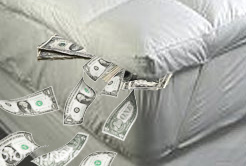
How Student Loans Increase Your Tuition
People are complaining, as they should, about how tuition prices are shooting up far faster than inflation…in fact, how they went up even faster while the economic depression had prices stagnant or falling, nationally.

The commodity subsidized the most, is the one that's gone up the most in price. In fact, each of these is inflated in accordance to its subsidization, although energy's short-term volatility is a result of our self-destructive foreign policy.
It seems that the more the government increases grants and student loans, and gives special breaks to students or parents to help them pay for college, the more those prices shoot up and undo that benefit.
But this is not a coincidence. It’s exactly what must happen, because of those student benefits…and the more the government hands out student aid, the more the laws of Supply and Demand and of Unintended Consequences will force tuitions higher:
Subsidies
When you give away money to help people buy something in an industry, it’s technically called a “Subsidy“…and the primary function of a subsidy is to raise prices. The government, unfortunately, often does just that, on purpose, giving a subsidy in an industry because it’s been bribed by lobbyists to place the profits of the producers over the needs of the members of society (aka consumers). Farm subsidies are how it keeps milk and other staples too expensive for poor people to buy without the government’s own “help”, for example.
 The way a subsidy works, of course, is that you increase the number of dollars available to buy the product, while the actual demand for that product, and therefore its supply, stays more or less the same. If people generally choose to spend a one hundred million dollars per year on apples, and they average $1 a pound, then the government offers people an extra fifty million dollars to “help” them buy apples, the average price of apples can increase to $1.50 a pound, driving up prices of pies, and giving poor people one less healthy snack they can afford. That’s a bit oversimplified, but pretty much how subsidies are used.

Sugar cane is cheaper, and better for the environment than beet sugar, but punished by a beet subsidy
People didn’t actually want beet sugar more than cane sugar, the government simply threw more money at it, so that there was more to spend, and prices rose to a new level. Why? Bribes from beet farmers.
Of course the poor benefit from the inexpensive calories of sugar, so this hike in prices caused them to go hungrier…but they don’t have lobbyists as powerful as the more corrupt and irresponsible farm organizations do.
But money poured into an industry to pay for its goods is a subsidy, with the price-boosting impact, no matter whether that’s the official intention or not:
Health Care Prices
For example, Bush’s own socialized medicine plan, Medicare Part D, threw hundreds of billions of dollars at pharmaceutical companies, for the same medicine that was already out there. Naturally, prices went up even higher, helping precipitate the “crisis” that was used to pass Obamacare…and the Obama administration now admits that, indeed, the added money from Obamacare has caused health care prices to shoot up even faster, even in the short time since it was enacted…and contrary to the claim that it had to be rushed through to reduce prices.
In fact, if you track health care prices through the past century, they shoot up each time the government imposes a program to “help” pay. The largest increase was immediately after Medicare was implemented.
College Tuitions

The Occupy Wall Street movement is correct to complain about the massive debt created by student loans...because those loans have increased tuitions, tenfold.
Therefore, it’s really no surprise that college tuitions go up each time government grants and loans increase, even when the economy is weak and driving many other prices down.
In fact, with the government’s fake “student loans” and grants now making up the majority of all money spent on tuition, it would be impossible for tuition prices to do anything but be inflated by many times what they would be if colleges had to actually compete for student money, directly.
People are, right now, complaining loudly about how tuitions are going through the roof…but Big Brotherment’s response has simply been to throw even more money at tuitions, like Obama’s recent, unconstitutional Executive Order, even though this will just increase tuitions more.
It’s as if your doctor’s proposed response to emphysema was for you to chain smoke, because the nicotine will make you feel good.
Is the Fed Wagging the Dog?

Why is the Fed causing deflationary hording, then "fixing" it with inflationary money?
In 2008, banks stopped lending as much money, helping drag the economy down.
They started holding it in extra reserves, instead.
This caused deflationary pressure the Federal Reserve has been “protecting” us from ever since.
We’re so lucky we have the Fed.
But why did the banks start holding excess reserves instead of lending? Were they simply scared of the economic conditions?
No, they are being PAID to do it, by the Federal Reserve.
That’s right…the Federal Reserve that is “saving” us from the banks’ refusal to lend, is paying the banks to do it.
How the Banks Work
See, banks usually take the money you deposit, and invest it. They make business loans, home loans, buy securities, and so on.
The profit they make doing that pays for the banking services they “give” you “free”.
In a sense, they are acting like a mutual fund for you…investing your money and paying you “interest” in the way of free banking.
But they don’t invest all of your money. The Federal Reserve requires them to hold back a bit “in reserve”. This is to ensure that they have money in case people want to withdraw it.
The Fed makes banks hold 10% of your checking account (and everyone else’s) in their Reserve.
The other 90%, the bank invests, driving the economy through business loans, buying securities, et cetera.
Or it did.
The Fed Wags the Dog

Up to 2008, EXCESS reserves were usually at 0. When the Fed started paying banks to hold them, this excess shot through the roof
But in 2008, the Federal Reserve started paying banks interest for anything they held in reserve.
Immediately, banks started holding EXTRA money in reserve. This is called “excess reserves”, and it had never happened in any large amount before.
Strangely, the Fed’s response to the banks doing what it is now paying them to do has been to complain that they’re doing it, and to expand its power even more, to “save” us from the lost money.
See, our capitalist economy depends on money being used to create wealth. With hundreds of billions being stuck in “reserves”, it’s not being invested to create wealth, and the economy is suffering.
In effect, the Fed is causing what Friedrich Hayek called “hording”, and identified as something that NO economic school considers healthy.
It is agreed that hording money, whether in cash or in idle balances, is deflationary in its effects. No one thinks that deflation is in itself desirable.
— Friedrich Hayek’s 1932 Letter on the Great Depression
If banks respond to free market demand by increasing their reserves, that’s good.
If the government (including the Fed, acting as its agent) forces more reserves, that’s bad.
The reason the Fed has added, or says it is adding, over a trillion dollars in “Quantitative Easing” (including the recent QE2) is to fight the deflationary effects of banks “hording” in their reserves.
This “easing” is the printing of temporary money the Fed uses to buy securities. It hopes that money will get spent without going into excess reserves…but this is dangerous, because that extra money could cause inflation after the economy recovers.
The Fed hopes to sell those securities and destroy the money it gets back, but history says it will respond almost two years too late, leaving us suffering inflation.
So the Fed is risking dramatic inflation, in order to save us from the risk of deflation it is paying the banks to create in the first place.
Many thanks to Steve Horwitz for his feedback during the writing of this article.
Forget the Fed

The Federal Reserve, though bad, is a scapegoat, and ending it would neither reduce the deficit, nor rein in the printing of money
Among my political companions, “End the Fed” has been the hot, trendy thing for a while. This is mainly because Ron Paul correctly distrusts it, and has sponsored a bill to have it audited.
Now, I almost named this article Eff the Fed, because I, too, dislike it, and know it can never manage money properly…no government agency ever could. Instead of the a fiat dollar, we should have a free market in currency, like the Austrian economist Friedrich Hayek advocated . But when it comes to the fight to end it, there’s a problem.
The End the Fed crowd seems to think that getting rid of it is some magic bullet, that will accomplish all kinds of different things.
They believe it will:
- Bring back “sound money”, by imposing a gold standard.
- End the printing of new, extra money
- Restrain runaway government spending
- Prevent budget deficits
The problem is that ending it will accomplish none of those things.
In fact, it would probably make them worse.
Why?
Because the Fed isn’t what started those things happening, and none of them depend on the Fed’s existence.
Axe the IRS
In effect, fighting those things by attacking the Fed is like wanting to fight the income tax, and high taxes, by demanding “Ax the IRS”.
Obviously, we had taxes before the IRS, and we’d have taxes after it. In fact, the IRS was not created by the 16th amendment establishing the income tax, but five decades earlier, by Abraham Lincoln.
If we got rid of the IRS, we’d still have the income tax, and high taxes. Putting our time, energy, and money into attacking the IRS would be a waste of time, when we could have fought for actual tax reduction, reforming or ending the income tax, et cetera, directly.
What’s worse, the government would still want to oversee the taxes we failed to actually fix, and would probably end up using something worse than the IRS.
Well, all of this is true of the Fed, as well:
The Feds Don’t Need the Fed
The Fed and a Gold Standard are Compatible
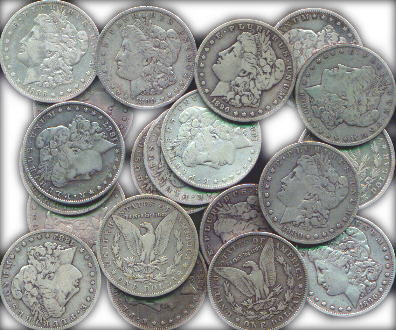
Trade Dollars, coins minted in the US during the gold standard, in an attempt to offset a shortage of money
Ending the Fed won’t bring back a forced gold standard, because they are two unrelated issues.
We had both at the same time for decades, anyhow.
The US had a fiat gold standard from 1873, through 1934.
The Fed, of course, was established in 1913. It existed alongside the gold standard for over two decades. It helped cause the Great Depression while the US was on a gold standard. It created floods of new money in the 1920s, and drew down the money supply by 30% (which would cause any economy, at any time, to collapse) in 1929…both of these things while we were on the gold standard.
Congress Would Just Print More Money
Not only did we have a gold standard while we had the Fed, but we also printed fiat paper money when we did not have the Fed. The reason the dollar is sometimes called the Greenback, is that this was the nickname commonly used for the paper money common in the United States in the 1860s and 1870s, printed to finance the Civil War, known for its green ink .
Right now, the Federal Reserve is a bureaucratic middleman, standing between Congress and simply printing money willy-nilly. The Fed uses what are ironically called “mechanical” means, to create its electronic, funny money for banks. In other words, it has a set of rules that cause the money to be created according to some specific set of conditions, not simply all the money the government wants.
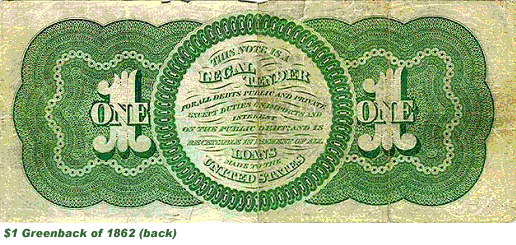
An actual Greenback, fiat paper money printed in the US before the Federal Reserve
Without it, Congress will simply mandate the printing of more money, on its own, surely in accordance to its bloated, and ever-snowballing spending. They printed floods of extra money before the Fed, and would print it after.
As with the IRS, however it replaces the Fed (and, in a sense, it will have to) will probably be with a mechanism that is even worse.
The US government issued treasury notes, and created deficits in other ways, for the majority of US history where there was no Federal Reserve Bank, and would do it again without it.
Restrain the Deficits…How?
This is the silliest one, and speaks to an ignorance of how the Fed works.
The Federal Reserve certainly responds to some deficit spending by selling more treasury notes…but as with printing money and collecting taxes, this would happen whether the Fed existed or not. It simply is the middleman, again.
You might as well blame the mailman for delivering your bills.
A Big, Fat Windmill
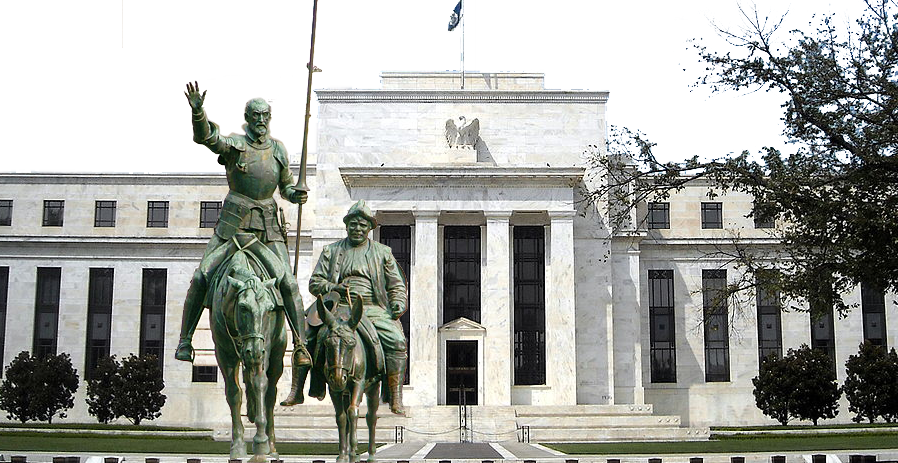
The problem with Don Quixote attacking windmills wasn’t just that the windmills wasn’t only that the windmills weren’t actually dragons, harming people.
It was also that he was wasting the energy and time that could have gone into fighting actual bad causes.
And that’s what the End the Fed noise is doing. This energy could be spent fighting deficit spending directly, which has run rampant under Democrat and RiNO alike…or any of dozens of other issues of government abuse.
It’s Going Nowhere
Of course the last problem with tilting at windmills was that it was never going to get rid of them, anyhow.
The Federal Reserve is in no danger of being “ended”. Ron Paul is actually only sponsoring a bill to audit the Fed, which (unfortunately) will not even permanently open its records to the public, the way they need to be. It will do even less to “end” it, since government self-investigations only ever are used to create a pretense that a few new regulations have “put the problem behind us”, and things usually just get worse, thereafter.
A majority of Americans oppose the drug war. Nearly all Americans not directly on the government teat oppose its massive spending and deficits. But the mechanisms for keeping the Fed in place, on both the private and public side, are massive. Not only would getting rid of it have no more effect than axing the IRS, but it’s no more likely to happen.
How To Actually Fix Things
What we need to do, rather than waste our time tilting at the Fed, is to directly address the problems we’re using it as a whipping boy to attack, or at least focus on their actual sources.
For example:
Balance the Budget; A balanced budget amendment would stop massive deficits, rein in government spending, and eliminate much of the incentive to print money and treasury notes, under the current system.
Line-Item Veto; Giving the President the power to veto any specific detail in any spending bill would be a step in that direction, as well. This may need to be an amendment, too, in order to override corrupt Federal courts claiming that it’s somehow unconstitutional.
Pull the Pork; Rules against pork, against Congress specifying projects in detail intended just to send money to their own cronies in their district, would be devastating not only to spending (which, unfortunately, is more centered on entitlements), but also to motives to give officials legalized bribes like campaign contributions.
Or maybe something else, entirely…but, whatever is done, it needs to be done. We need to choose surmountable obstacles that will actually matter, not waste our effort and attention on some scapegoat, however undesirable it is. The Fed is a poster child for government’s destruction of finance and economy, but what we need now is real solutions, not symbolic gestures, however satisfying this one would be.
Why Workers Dislike Unions
We’re told by teachers, politicians, and the media that unions are the best thing ever to happen to people who work. Without them, we’d all be working 80 hour weeks, for pennies per hour, and dying by 30 from how dangerous the conditions are.
And yet, for some reason, most people not only don’t belong to unions, are not even thinking about forming unions, but wouldn’t even want their industry unionized, if they had the chance. In fact, unions are dying out. The odds are that if you don’t more or less inherit a union career because you’re locked into a Company Town situation, you will never join one.

As Americans have gained more freedom to leave unions, they have mostly chosen independence
In the 1940s, 35% of American workers belonged to trade unions. Today in the private sector, membership is less than 7%. It is even lower in states that protect your right to have a specific job without joining a union.
Why?
Because, in reality, a union takes more freedom away from a worker, than from anyone else.
Pay is Important
It’s not fun, negotiating with an employer for your compensation. Well, not unless you’re really in demand. Then it can be joyful agony, trying to decide which offer is best, and what to require you be paid…but, the rest of the time, it’s unpleasant.
But the joy and pain are both because of how completely important your pay for your work really is. Your entire lifestyle depends on that set of decisions.
Not just how much you’ll be paid, but in what form. Do you want more cash, or would you prefer more days off? Are you better off putting up with a company insurance plan, that is cheaper but less responsive and lacking in choices, or more money and save up for your own checkups? Do you want paid lunch and breaks, or more money and come home sooner?
The problem with a union is that it strips away any control you have over that life-changing question.
You don’t even get to choose when, or how, to negotiate. Union management takes all power away from you, and you have to cross your fingers, praying whatever they think is best happens to be something you can tolerate.
Even under the best circumstances, they’ll be negotiating for the lowest common denominator. What the average worker is worth, and the union will gain from getting. The problem is that in the real world, almost nobody’s average. A good compromise, famously, is one where everyone goes away equally unhappy. With a union, you don’t just have to compromise with an employer, but also with all of the other workers.
You Become a Cog
With a union, you must settle for:
What the average worker is worth…
Diluted by what benefits the union management and corporate management negotiate.
You also lose the power to be paid for your effort, quality, ideas, and unique traits.
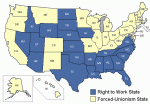
Right to work states protect your choice to not join a union, even if there is one at the company where you work
For example, you may be willing to work extra-hard to make more money, or have more job security. You may not even need to work hard; there may be some special part of your occupation you’re particularly good at.
But most unions avoid the idea of being paid for how well you do the job, replacing it with being paid for how many years you’ve worked. What could be a worse system of payment than this?
Of course it’s bad for the customers, because quality falls by the way-side…and therefore is bad for the company, as its profit depends on that quality. But it’s also bad for you, the worker, whose efforts become meaningless…just hang on to the job for as long as you can, that’s the only way you can make more money.
Likewise, no amount of effort can protect you from being laid off during the slow or hard times, with a typical union contract. You could be the very best at your job, but if you’ve only been there a few years, you’re out the door.
The Worst Kind of Middleman
It’s bad enough that unions harm companies, consumers, and society by causing unemployment, playing insider favoritism, price increases, inefficiency, low quality, reducing non-union worker pay, and other means, plus all the above disadvantages to union members, but what do you gain, in return for this?
- The right to be forced to pay union dues, whether you find them worthwhile or not.
- The privilege to have part of that hefty fee spent to bribe government officials with policies you probably don’t actually like, and be punished if you object.
- The fortune of having some of the rest divvied up among the secretive, corrupt union management and their cronies and masters, for no apparent reason whatsoever.
- Oh, and the joy of having yet another Tyranny of the Majority government ruling over you, in the form of that union’s quasi-elected crony management.

You have a right to set your own standards, not depend on a bullying middleman
It’s no surprise that unions actually reduce real household income.
Not a Number, but a Free Man
The reason most of us eschew labor unions like they’re a porcupine who recently attacked a skunk’s posterior, is that we really are better off as free people, than as vassals of a collective, whose real function seems to be the profit of its “leaders”.
In other words, I’d rather protect my right to earn pay based on what I’m worth, not my seniority, and not be given useless token “compensation” that sucks part of it away, like hourly coffee breaks and a dubious promise of unreasonably high, distant retirement pay, I probably won’t see, once the union bankrupts my employer.
Wouldn’t you?
Words of the Sentient:
Unionism seldom, if ever, uses such power as it has to insure better work; almost always it devotes a large part of that power to safeguarding bad work.
– H. L. Mencken
– Henry George
Where’s the Hyperinflation?
When the unaccountable, secretive arm of the banking industry known as the Federal Reserve started lending itself (the banking industry) billions of newly invented dollars, late last year, responsible people all over America were horrified.
Some of the soundest economic minds even started predicting “hyperinflation”.
Well, it’s been three quarters, now…soon it’ll be a year.
“Where,” other people are saying, “oh where is that oh-so-scary hyperinflation?”
The answer comes in several parts:
What is Hyperinflation? Hyperinflation is a specific thing. It’s not the three percent inflation we normally “enjoy”, any more than it’s a flavor of cream pie. We must define what it is, in order to know if it happens.
What Causes Hyperinflation? Having defined it, we need to know if the things that cause it are happening. The Fed has printed new money for nearly 100 years, never with hyperinflation. Is what happened recently sufficient to change that?
How Long Would it Take? Is it too late? It’s been nine months; are we safe?
Well, Let’s See
What is hyperinflation?

(caption: An actually hyperinflated currency; the Zimbabwe dollar was so weak that this is a single note for one hundred TRILLION. At the rate it printed money for two months last fall, the Fed would still need over eight years just to print enough to equal this one scrap of paper)
Well, “inflation” is when you increase the amount of money, or the supply of it compared to the demand for goods in society…but when non-economists say “inflation”, they usually mean “prices go up”.
And so “hyperinflation” is just “prices going up really, really fast”. The amount necessary to count is generally said to be “100% per year for three years”, for long-term hyperinflation, or else “50% per month” for short-term hyperinflation.
The most inflation we’ve ever suffered, in the 1970s, was less than 14% per year. Normally, it’s between 2% and 3%.
Right now, prices are going DOWN most months, not up. There isn’t even price stability now, much less price inflation.
But why would prices be going up OR down, in an unhealthy way?
Super-quick history:
Almost exactly 100 years ago, in 1907, the US suffered yet another in a long series of destructive depressions and panics, generally caused by money shortages creating runs on banks, price failures, stock market crashes, et cetera.
But this one was stopped dead in its tracks by a group of wealthy entrepreneurs who made very short-term loans to various financial groups, allowing banks to pay off depositors, et cetera. The result was the downturn cut short, never becoming a full-blown depression.
A brilliant lesson was about to be learned, but unfortunately government prevented that. Instead of a newish industry of short-term finance lenders/insurers springing up, the Federal Government announced it was going to act in that role, from now on. It created the Federal Reserve, which would use its coercive power to print imaginary new money to lend to financial institutions in times of crisis.
(Sadly, it did the opposite; it lent out newly minted money in good times, but tended to cut it off whenever there was a financial panic, which was the only time it was supposed to lend in the first place…this is part of what triggered the start of the Great Depression in 1929)
Well, the Fed is a whole other discussion, of course, so we’re going to skip ahead, now
Today:
So instead of lending out money during a crisis, the Federal Reserve increases the amount of money a few percent per year, lending it out in good times. This is part of why we have (usually moderate) inflation…the amount of money increases faster than the demand for goods, so there’s more money to spend than stuff to buy, and prices increase.
But from 2004 through 2008, the Fed did something it hadn’t done since 1938 when we went off the Gold Standard: It started DECREASING money supply:
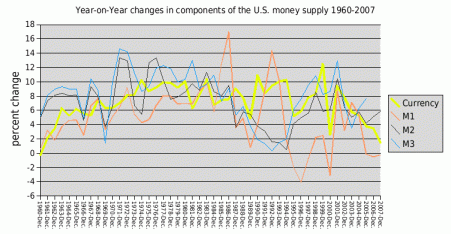
(caption: Notice that M1, paper money and electronic money in US banks, shrinks (goes below 0 growth) from 2004-2008)
Notice that the most important line, the red M1, goes below zero (to shrinking money), and stays negative longer than it had been at any but one time in fifty years. And currency (actual paper money) falls lower than ANY time in that span.
This is because M3, which includes money in foreign banks, was going up so quickly: Money was fleeing the US because of our wars, and the 700% inflated oil prices, and our billions in new foreign aid. We would buy oil that should have cost a few hundred billion, but instead cost us trillions, and send the money for that oil to Saudi Arabia, and other foreign countries.
Over the course of four years, this added up to a shortfall of between two and three trillion dollars in the domestic US economy. That money was all overseas.
Here comes deflation
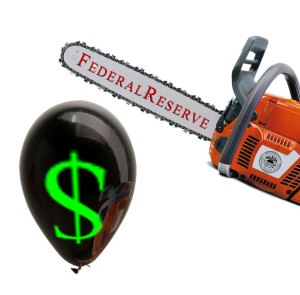
(caption: The Fed's monopoly could never work better than any other monopoly, and now it's produced deflation)
This didn’t even leave enough money to pay for our normal goods, much less allow the economy to grow…plus, of course, the cost of making things was shooting up from the high oil prices, as all things require energy, while there was LESS money to cover that universal new expense.
The result? Deflation, and therefore a money shortage, that led to the economic depression starting in 2008. There was not enough money to run the economy, so prices began FALLING, the US suffering what appeared to be a “loss” of about three trillion dollars. This was simply the change in prices to represent the trillions missing because of M1 shrinking for four years.
The Federal Reserve’s response? It actually CUT its offered money supply in 2008, by refusing to lend to banks suffering financial trauma…once again failing to act in its sole official role of “lender of last resort” as in 1907.
But it couldn’t keep that up, because deflation destroys a market economy.
So, once this cutting off of emergency money caused the banks to start failing, the Fed belatedly loosened its purse strings: It lend out over two trillion dollars to financial institutions, in just a few months.
Is It Enough to be Hyper?
Now if the Fed did this all the time, lending out a trillion dollars each month when the economy was just fine, we might really have hyperinflation.
But, instead, the Fed did this ONE TIME, starting from a money deficit of three trillion dollars.
So, in fact, what it did was produce enough new money to, hopefully, make up for the money shortage.
Being down trillions of dollars, then adding two trillion, could not make prices double every year. Or even once.
Even if there had been no shortage, two trillion is not enough to increase prices by 50% every month, nor 100% every year, because it is a fraction of the many trillions of dollars in our economy, and only happened one time. Hyperinflation requires more money to be printed even as prices are going through the roof, so that people come to expect it and overprice things ahead of time.
But, even if it had been enough to cause hyperinflation, there’s one last big factor:
Time delay.
How Long?
We can’t guarantee that there will be NO backlash from this infusion of money, until about 18 months have passed. Historically, changes in money supply take between 6 and 18 months to hit prices in an economy. It has to gradually spread throughout the system, being spent, invested, and saved over and again, until its full impact is felt and absorbed.
So we have until mid 2010 to see whether there are SOME effects from the unhealthy throwing of two trillion unearned dollars at our socialized banking institutions.
What About Government Spending?
For better or worse, it is actually impossible for government spending to “stimulate” an economy, at all. And since the current “stimulus packages” are financed by bonds and deficit, not the printing of money, they are actually DE-Flationary. Read the above link, to understand exactly why these things are so.
Sorry, Not Even Close
But, ultimately, whatever backlash there is, it cannot be hyperinflation. With an economy of, depending on how you count, eight to twelve trillion dollars, you can’t make prices jump even 50%, even for ONE month (and it must keep happening, to be hyper), by printing two trillion new dollars. Not even if there were not already deflation to counter.

The great danger, to this day, is deflation, not inflation, which can produce a long-term spiral of economic depression. What's worse, is that the Consumer Price Index, adjusted to compensate for annual cycles like Christmas spending and winter energy prices, showed deflation six months earlier than this chart.
Why Deflation is Bad…for You, Private Property, and Capitalism
Politicians and journalists are worried, right now, about a downward spiral of deflation, of the type that normally comes in an economic depression.
They are pointing to two signs we are having bad deflation…first, the falling price of commodities like oil, and the disappearance of money in this economic failure causing demand to plunge. One of those is actually good, the other is very bad.
When prices go down naturally, because of an increase in efficiency or improvement in technology, it is good for everyone.
For example:
- Improved efficiency makes the manufacture of computers cheaper, while more advanced computers make the old versions cost less.
- Food used to take up most of humanity’s effort, therefore most of a family’s cost of living, but has declined to third or fourth place as technology and efficiency allowed us to grow more with less.
The decline in oil prices, returning to only double their normal level, will cause a good kind of global price decline, because most prices are effected by the cost of the energy required to create and deliver products and services.
But, again, those specific cost reductions are not deflation.
What Are Real Deflation and Inflation?

When money deflates, people choose to just hold onto it, starving the marketplace and causing a spiral of ever more deflation
In real economic terms, inflation and deflation happen when the ratio of money to economic wealth changes. If the amount of money becomes greater, in comparison to the economy, then you get inflation. Because the most common result of this is for prices to increase, we confuse the terms and call general price increases “inflation”, but actually it’s the change in ratio that is inflation.
The eleven trillion-plus dollars of capital that have purportedly vanished in the past few months represent a huge decline in money supply, causing actual deflation. This failure was caused by the inability of central authority to manage money any better in the US than it could provide shoes and food in the Soviet Union.
Prices Can Increase Without Inflation, Too
Prices can actually increase for other reasons, and that’s not really inflation. For example, when oil increased 600% in price, it drove up the cost of production, without regard for the number of dollars in the economy. This general price increase was NOT inflation.
And when prices decrease for other reasons, it’s not deflation.
Inflation is Harmful
We all know that when the ratio of money to wealth increases, causing inflation, it is bad for the economy, and especially for the poor and middle classes. This is because it usually drives up prices, and the poorer you are, the more of your wealth and well-being is in cash.
Poorer people depend on cash they have in a bank, or other savings. They are paid by employers who give them only a set rate, plus raises for special reasons like increased skill.
Wealthier people tend to have more of their wealth in assets like, stocks and real estate, that will simply increase in price, sheltering them from some of the effect if inflation. They get cost of living increases in salary every year, on top of any other raises.
Deflation is Harmful, too
But the opposite kind of damage occurs if you have deflation, and is compounded by a new problem.
First, deflation artificially drives down prices. To a person with no real assets or investments, this sounds good, because “stuff costs less”.
But it comes at a horrible price.

Deflation punishes investments that can raise people from poverty, both personal investments, and business growth
For example, the decline in prices includes wages. Deflation is universal, with a shortage of money everywhere, so that your income will decline, along with the price you pay for things. What good is cheaper stuff, if you also have less money?
So people with fewer assets and no investments will more or less end up breaking even. But they still lose out in the end, because they become blocked from gaining assets, trapping them in relative poverty.
For example:
How Deflation Traps the Poor and Middle Class
Imagine you’re buying a house. Not on a sub-prime loan, but one where your income is perfectly fit for the home you’re getting.
It’s probably a thirty year loan. So you’re going to be stuck paying on the original price of your house, for thirty years, at the original size of house payment.
Now remember that your income (in dollars) is getting smaller every year. That’s deflation.
And the price of your house, too. Each year, its is worth fewer dollars, yet your original debt is the same. And so are your payments.
Within just a few years, you are making far less money, but are stuck with the same size house payment you always had.
While you still have to pay the same percentage of of your paycheck income for food, electricity, and so on, your house payment takes up a higher percentage of that money every year.
Soon, your income has shrunken to the point where you cannot make your house payment at all. Not even if you paid your whole check to the bank every week.
And worse, you can’t simply sell his house to get out of it. The price of your house has also declined every year. Selling it now that the payment is too high won’t even pay off your remaining house debt.
Of course people would quickly learn this, and that they simply cannot buy houses, unless they are so incredibly wealthy that they can save up enough to pay cash.
But even those wealthy people who can pay cash for a house now face the situation where buying a house is a horrible investment, because the house’s value will decline, in dollars.
It would actually be better to leave the money in a vault, and rent monthly, even for a billionaire, because the money’s value increases, while the house’s price declines. One thousand dollars will be worth more next year, if you simply stick it in your mattress, than one thousand dollars worth of house will be worth in that same year.
In fact, owning land becomes a losing proposition. With even the wealthy better-off renting, who’s going to actually be the landlord?
Deflation Attacks Economic Freedom
In fact, ALL property ownership becomes punished!
With deflation, anything you buy does not just depreciate with use and age, but declines in value every year with prices, compared to if you’d simply kept the money.
Today, you could buy that console game, or car, or collectible, and then sell it on eBay a few years from now and recoup part of the cost. But with deflation, the price you recoup is even farther from if you’d kept the cash in the first place.
Deflation Destroys Capitalism

Deflation punishes investment and property ownership, attacking capitalism at its roots
In fact (and this is where the entire economy implodes from deflation), simply holding on to your money is rewarded versus ANY investment, in a deflationary economy. If you put your money in a big ol’ vault, removing it from the economy entirely, it grows in value every year. But if, instead, you buy stocks, or invest in commodities, then your money is gone, replaced with an asset that becomes worth less every year, in dollar terms.
The growth of every business, in fact, would be undone by the rate of deflation. Now from the company’s standpoint, that is fine, because its expenses decline every year by the same amount.
But from an investor’s standpoint, a company growing at 2% per year during 3% deflation would mean you lose 1% over just stuffing your money in a safe. And yet you also risk, when investing money.
Why bother investing even in a company you think might grow at 5%, when you could have a 100% safe 3% investment in a vault under your mattress? So, really, the company facing deflation is NOT fine, because it discovers that it’s far harder to get investors. In fact, the entrepreneur who would have started that company is 3% punished each year for the effort, making him that much less likely to even bother.
With investors discouraged because of deflation, it becomes harder to create wealth. Capitalism, in fact, becomes almost impossible:
- An entrepreneur can’t get investors for his new project.
- There’s less reason to buy stocks, so companies can’t raise capital.
- You can’t get a loan to start a business, because your company’s income would decline every year, yet the loan payment would stay as large as ever.
With deflation, the very engines of capitalism all die out.
Speculation Defines Capitalism
It is the uncertain investment on the wild new idea that makes capitalism superior to central planning. Anyone can decide to invest in a “sure thing”: if that were good enough, socialism would work, because a government bureaucrat could declare money for the obvious solution. It’s diverse people choosing to risk money on many different wild ideas that lets the best solutions rise to the top.
But that very kind of capital investment, in a deflationary economy, is punished, because you get such a good deal by not investing in anything at all, but holding your money in a vault.
All of this, by the way, is aside from the additional destruction caused by the lack of downward price elasticity on many commodities and time-based investments. That’s much more arcane, but a key source of economic depression, that I’ll get into some other time.
For now, it’s enough to realize that prices being FORCED downward by deflation includes your pay, and the value of any investments you make, so that private property ownership, borrowing, and investing, in fact all capitalism, is crippled under deflation.
About
 This site has its origins before the word “Blog” existed. Back then its owner, Kaz, was simply thought of as having a website that published socio-political articles with regularity…But the only real difference was that the RSS/XML protocals were not yet used this way.
The website was known as Site of the Sentient, a reference to the famous Words of the Sentient, that Kaz had been editing for years previously.
When some random portal site hijacked the domain siteofthesentient.com, it was a dark time for the human knowledge quest. Fortunately, But Now You Know is striving to take up the slack, and even has some revamped versions of the original articles, for example Conscription, is it Slavery, and How to Get Out of Jury Duty, and be a hero instead of a bad citizen.
Kaz is a writer, graphic artist, and supplements his income by being a hardcore senior web developer.
Along with this blog, you can track his efforts with the dedicated facebook page here.
Speaking of tracking:

You can follow But Now You Know here, on Twitter

And you can follow But Now You Know, via our Facebook Page, here.
Share This Article

 Words of the Sentient
- Tolkien, on Government
- Criminals Are Never Disarmed — Robert Heinlein
- Power Attracts the Corrupt — Frank Herbert
- Under Democracy — H.L. Mencken
- Guard Your Enemies from Oppression —> Thomas Paine
- Your Right to Not Support Evil
- Global Warming Shamanism
- The Squeaky Wheel…May Be Foolish
- Disarming the Victims
- The Inconvenience of Too Much Liberty
Recent Comments
- Pithy Pontifications
- An error has occurred; the feed is probably down. Try again later.


 But Now You Know