Check out the Worker’s Rights Manifesto
You and I, as a workers, have certain rights that are naturally ours, and that nobody should be allowed to violate. These rights are choices we are free to make, unless the powerful try to steal them.
The right to work for the amount we choose.
What we earn should be a matter between ourselves and our employers, not something controlled or approved by some government…more
The right to work for whom we choose.
Where we work should be a matter of which job offer we accept, not controlled by some law or.…more
The right to keep the product of our labor, and do with it as we choose.
The product of our labour is the amount we agree to sell our services to an employer for. It is ours by right, and any authority who takes it from us for their own purposes is wrong.…more
The right to decide how we work.
What if we don’t want three weeks off, but would like a little extra pay, instead? What if we want to buy health insurance with a huge deductible for two hundred bucks a year, instead of paying two hundred bucks per month for full insurance, because we have a lot saved up in the bank in case we get sick? Nobody should be able to.…more
The right to work the way we choose.
We have a right to decide what is “safe”, for ourselves, instead of.…more
The right to become owners / management, and be proud of it.
If we work hard, and make the sacrifice of saving our rightful income (product of labor), or work in our own time to create a great new idea, we have a right to invest it to create new wealth.…more
Where’s the Hyperinflation?
When the unaccountable, secretive arm of the banking industry known as the Federal Reserve started lending itself (the banking industry) billions of newly invented dollars, late last year, responsible people all over America were horrified.
Some of the soundest economic minds even started predicting “hyperinflation”.
Well, it’s been three quarters, now…soon it’ll be a year.
“Where,” other people are saying, “oh where is that oh-so-scary hyperinflation?”
The answer comes in several parts:
What is Hyperinflation? Hyperinflation is a specific thing. It’s not the three percent inflation we normally “enjoy”, any more than it’s a flavor of cream pie. We must define what it is, in order to know if it happens.
What Causes Hyperinflation? Having defined it, we need to know if the things that cause it are happening. The Fed has printed new money for nearly 100 years, never with hyperinflation. Is what happened recently sufficient to change that?
How Long Would it Take? Is it too late? It’s been nine months; are we safe?
Well, Let’s See
What is hyperinflation?

(caption: An actually hyperinflated currency; the Zimbabwe dollar was so weak that this is a single note for one hundred TRILLION. At the rate it printed money for two months last fall, the Fed would still need over eight years just to print enough to equal this one scrap of paper)
Well, “inflation” is when you increase the amount of money, or the supply of it compared to the demand for goods in society…but when non-economists say “inflation”, they usually mean “prices go up”.
And so “hyperinflation” is just “prices going up really, really fast”. The amount necessary to count is generally said to be “100% per year for three years”, for long-term hyperinflation, or else “50% per month” for short-term hyperinflation.
The most inflation we’ve ever suffered, in the 1970s, was less than 14% per year. Normally, it’s between 2% and 3%.
Right now, prices are going DOWN most months, not up. There isn’t even price stability now, much less price inflation.
But why would prices be going up OR down, in an unhealthy way?
Super-quick history:
Almost exactly 100 years ago, in 1907, the US suffered yet another in a long series of destructive depressions and panics, generally caused by money shortages creating runs on banks, price failures, stock market crashes, et cetera.
But this one was stopped dead in its tracks by a group of wealthy entrepreneurs who made very short-term loans to various financial groups, allowing banks to pay off depositors, et cetera. The result was the downturn cut short, never becoming a full-blown depression.
A brilliant lesson was about to be learned, but unfortunately government prevented that. Instead of a newish industry of short-term finance lenders/insurers springing up, the Federal Government announced it was going to act in that role, from now on. It created the Federal Reserve, which would use its coercive power to print imaginary new money to lend to financial institutions in times of crisis.
(Sadly, it did the opposite; it lent out newly minted money in good times, but tended to cut it off whenever there was a financial panic, which was the only time it was supposed to lend in the first place…this is part of what triggered the start of the Great Depression in 1929)
Well, the Fed is a whole other discussion, of course, so we’re going to skip ahead, now
Today:
So instead of lending out money during a crisis, the Federal Reserve increases the amount of money a few percent per year, lending it out in good times. This is part of why we have (usually moderate) inflation…the amount of money increases faster than the demand for goods, so there’s more money to spend than stuff to buy, and prices increase.
But from 2004 through 2008, the Fed did something it hadn’t done since 1938 when we went off the Gold Standard: It started DECREASING money supply:
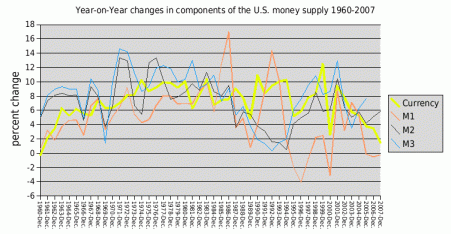
(caption: Notice that M1, paper money and electronic money in US banks, shrinks (goes below 0 growth) from 2004-2008)
Notice that the most important line, the red M1, goes below zero (to shrinking money), and stays negative longer than it had been at any but one time in fifty years. And currency (actual paper money) falls lower than ANY time in that span.
This is because M3, which includes money in foreign banks, was going up so quickly: Money was fleeing the US because of our wars, and the 700% inflated oil prices, and our billions in new foreign aid. We would buy oil that should have cost a few hundred billion, but instead cost us trillions, and send the money for that oil to Saudi Arabia, and other foreign countries.
Over the course of four years, this added up to a shortfall of between two and three trillion dollars in the domestic US economy. That money was all overseas.
Here comes deflation
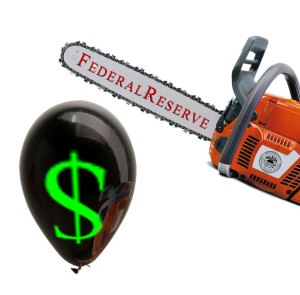
(caption: The Fed's monopoly could never work better than any other monopoly, and now it's produced deflation)
This didn’t even leave enough money to pay for our normal goods, much less allow the economy to grow…plus, of course, the cost of making things was shooting up from the high oil prices, as all things require energy, while there was LESS money to cover that universal new expense.
The result? Deflation, and therefore a money shortage, that led to the economic depression starting in 2008. There was not enough money to run the economy, so prices began FALLING, the US suffering what appeared to be a “loss” of about three trillion dollars. This was simply the change in prices to represent the trillions missing because of M1 shrinking for four years.
The Federal Reserve’s response? It actually CUT its offered money supply in 2008, by refusing to lend to banks suffering financial trauma…once again failing to act in its sole official role of “lender of last resort” as in 1907.
But it couldn’t keep that up, because deflation destroys a market economy.
So, once this cutting off of emergency money caused the banks to start failing, the Fed belatedly loosened its purse strings: It lend out over two trillion dollars to financial institutions, in just a few months.
Is It Enough to be Hyper?
Now if the Fed did this all the time, lending out a trillion dollars each month when the economy was just fine, we might really have hyperinflation.
But, instead, the Fed did this ONE TIME, starting from a money deficit of three trillion dollars.
So, in fact, what it did was produce enough new money to, hopefully, make up for the money shortage.
Being down trillions of dollars, then adding two trillion, could not make prices double every year. Or even once.
Even if there had been no shortage, two trillion is not enough to increase prices by 50% every month, nor 100% every year, because it is a fraction of the many trillions of dollars in our economy, and only happened one time. Hyperinflation requires more money to be printed even as prices are going through the roof, so that people come to expect it and overprice things ahead of time.
But, even if it had been enough to cause hyperinflation, there’s one last big factor:
Time delay.
How Long?
We can’t guarantee that there will be NO backlash from this infusion of money, until about 18 months have passed. Historically, changes in money supply take between 6 and 18 months to hit prices in an economy. It has to gradually spread throughout the system, being spent, invested, and saved over and again, until its full impact is felt and absorbed.
So we have until mid 2010 to see whether there are SOME effects from the unhealthy throwing of two trillion unearned dollars at our socialized banking institutions.
What About Government Spending?
For better or worse, it is actually impossible for government spending to “stimulate” an economy, at all. And since the current “stimulus packages” are financed by bonds and deficit, not the printing of money, they are actually DE-Flationary. Read the above link, to understand exactly why these things are so.
Sorry, Not Even Close
But, ultimately, whatever backlash there is, it cannot be hyperinflation. With an economy of, depending on how you count, eight to twelve trillion dollars, you can’t make prices jump even 50%, even for ONE month (and it must keep happening, to be hyper), by printing two trillion new dollars. Not even if there were not already deflation to counter.

The great danger, to this day, is deflation, not inflation, which can produce a long-term spiral of economic depression. What's worse, is that the Consumer Price Index, adjusted to compensate for annual cycles like Christmas spending and winter energy prices, showed deflation six months earlier than this chart.
It’s OK if it Kills People

(caption: Standing by a minicar, crushed in a test against a mere mid-sized car: "The laws of physics can't be repealed. Even with modern safety features like multiple air bags, people in small, light cars are always at a disadvantage in crashes." -- Russ Rader, Insurance Institute for Highway Safety (click picture to see video))
It’s bad enough that new gas mileage standards will cost the already-struggling US automakers at least $21,000,000,000 per year, which they will pass on to YOU, either in as consumers or taxpayers, but they also can TRIPLE the chance of your family dying in a car crash.
The new CAFE standards require automakers to have a much higher average gas mileage within a few years. But since automakers can’t force people to buy smaller cars, this means they must stop making larger cars, in order to force the “average” bought to be more efficient.
GM, for example, is going to literally stop selling the Caprice, one of its most popular and longest-made cars, to regular people…because it’s large. It will only offer those to “fleet” buyers, like police, taxi, and limo companies. Each company will also make the cars it does offer smaller and lighter. You will have no choice but to buy these, if you want a new car.
And, of course, you will be forced to finance this change through your taxes, with the new Cash for Clunkers law, while Cap and Trade (if you let it pass) will cause more car shrinkage and insane tax burden on you than CAFE and Cash for Clunkers combined.
Forced Green = Death

(caption: You're three times more likely to die in a small vehicle than a large one)
Yet no expert seriously denies that smaller cars are far more dangerous than large cars. They may refuse to use those exact words, but crash test results like this are not just normal, but a question of physics.
When a car hits something, its size, weight, and the materials out of which it’s made decide how much harm will come to its passengers. This is true even when an immobile object like a fence or tree…but it’s most true when hitting a moveable object, like a deer or another vehicle. These factors determine how much of the energy goes to moving the object you hit, and how much to crushing your body.
Even if your car has a rigid steel frame (Smart cars) and crumple zones (European cars), the change in speed from hitting a heavier object will snap your body around and kill you.
So when Barak Obama and John McCain attempt to force through standards that will effectively ban the building of larger vehicles for families, they are condemning many people to death. But, they say, this is worthwhile in order to force greater fuel economy on regular people.
Efficiency is more important than human life.
In 2004, a study by Dynamic Research, Inc. found a a 20% change in the weight difference between two vehicles in a collision produced a 15% change in mortality. The motivation, of course, was to show that people needed to be forced to drive lighter vehicles; punish SUV owners by reducing the side of their vehicles…but a more rational way to look at it is that, since large vehicles (and deer, and trees) will not cease to exist, a 20% reduction in the weight of new cars means a 15% increase in the death of families riding in them.
Your Death: A Risk They’re Willing to Take

(caption: Never fear; Barak will remain safe in his gas-hogging limosine)
Not only will there continue to be industrial vehicles, tractor-trailor rigs, and other necessary vehicles on the road to hit your shrinking family car, and not only will the deer you hit not be on a corrresponding diet, but bear in mind that the “fleet vehicles” the politicians use are effectively exempted. So Obama, McCain, government officials, and their loved ones will still be safe in their gigantic limosines, massive taxis, and ponderous police cars, to collide with and crush we mere mortals.
Statistically, you are twice as likely to die in a small car than a larger one, during a crash…THREE times as likely, if it’s a single-car crash. That’s right; you don’t have to hit an SUV to die from driving a small car: The more your car weighs, the more it can push back against the object it’s hitting, reducing the speed at which your body is jerked in an accident.
In fact, in a recent test by the Insurance Institute for Highway Safety, smaller vehicles even proved doomsday devices in crash tests against mere mid-level vehicles. It’s not just that a smart car will kill you if it collides with an SUV, but even a normal sedan…and when the new laws are in effect, the normal sedans being made then will be death traps against one made today.
So if a Cap and Trade politician’s limosine crashes into your family car, a few years from now, you (not he) will be far more likely to die than today…but that’s ok, it’s a chance he’s willing to take.

The Mid-sized sedan is slowed moderately by the impact, but the minicar reverses direction in a fraction of the distance. Outcome: Sedan's driver; pissed off, smartcar's driver; dead
Why Stimulus Spending Depresses the Economy
There is a good reason why Bush’s “economic stimulus” plans helped land us in economic depression, and why Obama following that precedent with bigger, badder stimulus plans will do even more harm.
It is the same reason why Japan’s “stimulus plans”, upon which ours were partially based, kept them in an economic depression for a decade, and did the same thing in Sweden.
Here’s How
- Lost Money: Every penny spent is taken from the private sector: whether through taxes; or by borrowing that robs from private investment, so nothing is gained. Then that money is wasted before it’s spent, because of the cost of bureaucracy, red tape, political motivation, and the lack of any control over the benefit of what it’s spent on.
- Crowding Out: The government spending competes with private spending, but has no checks or balances, no responsibility, so that it can crush the private competition out of the market, causing more economic harm instead of helping. It hires away workers and managers with large budgets, yet contributes less. It draws away research and investment from the private sector, et cetera.
- Chilling Effect: Healthy private investment and behavior is seen as punished, as unconditional public spending displaces it. Government spending tends to reward failure, and not to create wealth, while private spending depends upon productivity and success to expand. Bad companies, which do not contribute enough to society to justify their existence, have their ineffective ways perpetuated, instead of being excised and replaced with new competition.
Lost Money
Your Neighbors
 Your neighbors are planning to upgrade all of their crappy single-pane, wooden windows to nice thermal-pane replacement windows.
(Don’t ask how I know, just work with me, here…)
Your neighbors, therefore, shall cause the full employment of a team of six carpenters/installers, for one week. And those workers will, in turn, use their pay in ways that end up rewarding others, by spending or investing.
Of course they’ll also be profiting the company that sells windows, which in turn will reward its suppliers by ordering more, et cetera.
Your neighbors will, too, have nicer windows. Their house will be more comfortable. They will save money on their energy bills. And, if they are Global Warming True Believers, they will also feel very good about their effort to save the earth.
All of this benefits society and the economy. Even the feel-good parts.
Big Brother
But perhaps your neighbors will be prevented from doing this, by Big Brotherment.
Maybe their taxes are, or will be, high enough that they won’t be able to afford to buy those thermal replacement windows.
Perhaps, in fact, the amount necessary to upgrade their house will, in fact, be spent on a Stimulus Package, funded by their taxes.
That tax money, instead of being spent on their house, will instead filter through the government bureaucracy. The majority of it will actually be paid to bureaucrats, who produce nothing but paperwork and rules.
What’s left, in theory, will go to some union contractors in Iowa, to finance a Corn Museum. Never mind that Corn makes more money for its producers than any other crop, the government is financing this to “stimulate” the economy.
So a team of three union carpenters will get paid for about five days, based on your neighbor’s tax money. Three, because a majority of the money was lost to red tape, and only five days, because the union monopoly dominating the government contract in question is overpaid.
Better still, once their hourly coffee breaks and four mandatory half-hour breaks are deducted, and you take into consideration the bizarre “safety” rules in their contract, that leave them standing around more often than working, what you will actually get is about the amount of work one carpenter’s could do in five days.
And it will be dedicated to building the 23rd corn museum in the United States.
So the options are:
Free Market
- Your neighbors get a house full of thermal windows.
- Six carpenters get fully employed for a week.
- A window company is rewarded for improving the lives of your neighbors.
- Money is saved on energy.
- The planet is no longer doomed.
Government Stimulus
- Iowa gets 0.01% of a corn museum.
- Three carpenters get employed for five days, to do the work of one carpenter.
- People may, if the project is ever finished using other people’s tax money, get to save an hour over driving to the privately funded corn museum next door in Illinois.
Now a government bureaucrat will, in defense of his precious Pork budget, say “but we can’t be sure your neighbor will buy thermal replacement windows!”
But, quite frankly, we can be just about 100% certain that they will spend it on something they value. I’m not entirely clear on how even pet rocks and full body massages would be any less of a contribution to the economy than another corn museum.
And, seriously, much of the government’s spending benefits society less than corn museums, too.
Bridges to nowhere, two thousand dollar toilet seats, military equipment the generals said they didn’t want, but some senator insisted on funding because it is built in his state, methadone for junkies that is more addictive and toxic than the heroin it is replacing, free benefits for illegal aliens…
Face it, the corn museum was actually an optimistic example of government benefiting society.
Ultimately, each dollar the government spends must come from a dollar ALREADY taken from your pocket, directly or indirectly. There is no stimulation, because it’s just the same dollar. And, worse, YOU would have bought something you felt was beneficial, not wasted it on some bureaucratic make-work project.
Crowding Out

(caption: Buying stuff on closeout from a bankrupt company helps the economy far more than a government check, regardless of whether it saves the bankrupt company)
And let’s not forget that the government’s spending competes with private spending. There is a pressure against private industry, when it’s forced to compete with a government that can forcibly finance a project without any standards for success.
Workers
As noted above, if you are a carpenter, you can get a job where you are paid for what you accomplish, in the private sector, or you can get a job in a government contract where a union monopoly guarantees you more pay, for less work, a coffee break every single hour, and you’re not actually expected to even succeed, or do good work.
With government spending, therefore, one ends up with fewer skilled workers in the private sector.
Research
Better an easy government research job with no results required except regular publication of results, than private sector research, that must actually prove some contribution to society.
This is why things like cancer research and alternative energy research have produced only insanely expensive, ineffective results.
Business
Why build a privately financed corn museum, when there is a public one planned nearby? The free market depends on the pressure of demands, which can be supplied because of the reward of profit, fame, et cetera. All of which is quashed by public competition…producing LESS economic activity, prolonging, or even creating, economic downturn.
Investment
This is even true of investment. Why risk money buying stocks, or investing in any other resource that actually helps create wealth and grow the economy, if the government is issuing trillions in bonds that it can guarantee, at gunpoint, it will be able to afford to pay off?
This is part of why the US stock market is below where it was a dozen years ago; the past nine years of massive growth in government spending have crowded out even investment, depressing economic growth and the availability of money for business and individual use.
Chilling Effect
 Capitalism helps society prosper, in part, by requiring that businesses be efficient and useful, or else be displaced by other, better, more efficient competition. Government “stimulus” spending helps bad behaviors and inefficient companies survive, preventing the openings for new, better ways.
Reward Failure
Government spending, too, has to reward failure and punish success, directly. Not just by bailing out failures, but with its own agencies: It would be irresponsible to expand the budget of a project that was already coming in ahead of schedule and under budget. What a waste of taxpayer dollars! Instead, if the agency wants to expand its budget, it must fail. It must show how it is over budget and behind schedule, and how natural this is, how more money and power will help it achieve its goals.
Punish Success
Meanwhile, responsible, productive businesses are punished for their contribution to society.
What if Ford ends up the weakest of the three automakers, because it didn’t take the thirty billion taxpayer dollars and declare bankruptcy? What does this tell companies in other industries, when they’re considering whether to be productive, or else squander money and go crying to the stimulus committees for bailouts?
Government Gangrene
There are hundreds of billion dollars in bad investments, loans, et cetera, that need to simply fail, because they cannot ever be productive. Right now they are gangrene on society’s body, just burdening our health and slowly spreading…but the stimulus/bailout money keeps them from being removed, and even helps them expand, quashing healthy alternatives.
The Solution
In each case, around the world in history, the only way to get out of economic depression was for the government to STOP killing the economy with its fake “stimulus” packages.
Examples
It took Japan and Sweden ten years to figure this out. Some other countries never have, and still are suffering for it.
Even in the US, the government constantly expanded spending to “stimulate” from 1929 through 1938, and only truly enjoyed healthy economic growth when spending and regulation were massively cut in the late forties and fifties.
The opposite of this was the depression of 1920-21, where banks failed, commodity prices plummeted (like housing prices now), the stock market crashed…and the US government did virtually nothing.
That lack of “stimulus” resulted in a depression less than two years long, unlike the decade of the other examples.
Check out the extensive history of economic downturns in the US, for more.
Self-Transfusion?
Ultimately, government spending actually sucks the life out of the economy, increasing and prolonging economic depression, because it must take private money in order to “spend” the public money…as if you gave yourself a blood transfusion by taking blood your left arm and putting it in your right…with the stress of the transfusion actually leaving you weaker than when you started.
Why Do Good People Hope Obama Fails?

(caption: Hoping The People succeed often means hoping a specific politician's agenda will fail.)
There was a recent hue and cry about Rush Limbaugh saying he hoped that Obama would fail.
But he has plenty of people on his side…from all over the political spectrum. Why?
Look not at the words a politician uses to adorn his proposals, but at the things it will actually produce.
There is a huge gulf between the pretty things Obama promises, and the poverty and tyranny he, like his predecessor Bush, would deliver if successful.
Progressive “Universal health care”, anywhere in the world, produces universally short supply and slow progress of medical technology.
“Renewable energy” has been the promise of government for forty years, but all that it’s ever produced is renewable economic malaise.
“Comprehensive immigration reform” means bundling bad ideas with good ones, for an overall worsening of conditions.
Our economic depression was caused, in part, by high energy prices (because of Bush’s insane foreign policies driving the price of oil up 700%). Now Obama promises to drive up energy prices even higher, on purpose, in the name of “global warming” that ignores the past two years of global cooling…and we should wish him to succeed?
Canadians illegally sneak to the US to get health care, when suffering or even in danger of death, because it can be months, or even years, before their own system rations out treatment to them. Britain actually bans life-saving treatments it deems “too expensive”. You’re not even allowed to buy them for yourself, much less get them “free”. The whole problem with US health care, in the first place, is that government has been increasing the “universal” and “free” parts for over forty years, stripping consumer control from our hands, causing prices to go up and service to plummet…would we really hope Obama manages to make that rationing universal?
There are debates, in America, over:
* Whether jobs should be protected from new immigrants, or they will increase wealth and demand enough to be a net plus
* Whether people who have broken existing laws in order to sneak into the country, by tens of millions, should be given blanket amnesty, or have to go back home and start over legally, or simply be thrown in prisons or exiled permanently.
* Whether tax-paying, productive people should be forced not only to subsidize poverty and failure among formerly tax-paying Americans, but even for foreigners who show up illegally just to get the free handouts, as is helping bankrupt California right now. Should their children suffer for their wrongs, or just the children of people who pay taxes?
All of those debates should be settled, separately. Lumping separate issues together to force people to take the bad ones in order to have the essential good ones is one of the great crimes of modern government.
But we must hope he succeeds in this?
That’s not the kind of “hope” people voted for in 2008.
We hope THE PEOPLE succeed…which often means hoping a specific politician’s agendas fail, completely.
About
 This site has its origins before the word “Blog” existed. Back then its owner, Kaz, was simply thought of as having a website that published socio-political articles with regularity…But the only real difference was that the RSS/XML protocals were not yet used this way.
The website was known as Site of the Sentient, a reference to the famous Words of the Sentient, that Kaz had been editing for years previously.
When some random portal site hijacked the domain siteofthesentient.com, it was a dark time for the human knowledge quest. Fortunately, But Now You Know is striving to take up the slack, and even has some revamped versions of the original articles, for example Conscription, is it Slavery, and How to Get Out of Jury Duty, and be a hero instead of a bad citizen.
Kaz is a writer, graphic artist, and supplements his income by being a hardcore senior web developer.
Along with this blog, you can track his efforts with the dedicated facebook page here.
Speaking of tracking:

You can follow But Now You Know here, on Twitter

And you can follow But Now You Know, via our Facebook Page, here.
Share This Article

 Words of the Sentient
- Tolkien, on Government
- Criminals Are Never Disarmed — Robert Heinlein
- Power Attracts the Corrupt — Frank Herbert
- Under Democracy — H.L. Mencken
- Guard Your Enemies from Oppression —> Thomas Paine
- Your Right to Not Support Evil
- Global Warming Shamanism
- The Squeaky Wheel…May Be Foolish
- Disarming the Victims
- The Inconvenience of Too Much Liberty
Recent Comments
- Pithy Pontifications
- An error has occurred; the feed is probably down. Try again later.


 But Now You Know